Saturday, September 12, 2009

Memorial service of late CM Andhra Pradesh in Malaysia

Santapa Sabha in honor of our late C.M of Andhra Pradesh - Dr. Y.S. Rajasekhara Reddy Garu

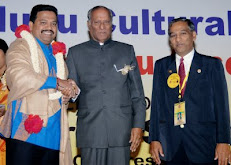
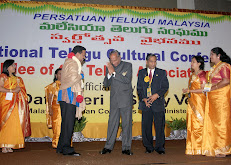
On 11/9/2009 about 100 Telugus and others gathered to pay tribute to the late C.M. Dr. Y.S. Rajasekhara Reddy Garu at the Indian High Commission Kuala Lumpur.Malaysia
Smt Durga Priya was the Master of Ceremony of the event who read out detailed biography and also recited a Telugu poem about the late C.M. Dr. Y.S. Rajasekhara Reddy Garu.

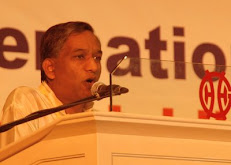
Sri Dr Achaiah Kumar Rao, President of Telugu Association of Malaysia (TAM) thanked all those who attended and highlighted that late C.M. Dr. Y.S. Rajasekhara Reddy Garu(YSR) is a great lost not only for India but also the Telugus outside of India. As it was during his term that AP Government provided about 6000 Telugu primary text books for our Malaysian Telugu students and even allowed Telugu teachers from AP to help the holiday classes conducted in Malaysia. The President went on to say that "I hope and pray that good tides with the Government of AP would continue".

The guest of honour for the event was His Excellency Ashok K. Kantha, Indian High Commissioner of Malaysia who also added that it is very saddened to lose a great leader of his kind. His Excellency added Dr YSR initiated a variety of programmes that influence the Economy of Andhra Pradesh and for the benefit of the common people and farming community.Followed by Indian classical music by Sitarist Steven and tabla specialist Sri Ravi.

After which Sri B. N. Reddy Garu, Deputy High Commissioner was kind enough to share his views about the great leader how he was able to touch the hearts of the people of Andhra Pradesh as some of them could not accept the fact that YSR has demised, and they took their own lives.
Sri B. N. Reddy went on say about Dr YSR programmes like JalaYagnam as to improve irrigation facilities to the farmers,and the health insurance and emergency services scheme for rural masses where the government pays the entire price of any surgery up to 200,000 rupee and does not require people to pay any premium and Pavala Vaddi a program that provides loans to people at 3% per year so as to encourage them to take up small scale businesses rural women and reimbursement and reservations colleges fees for minorities.The event ended with light refreshments.
Sri Vengkatesh, Vice President of TAM was the Coordinator of this event who also presented a slide show about the Dr YSR.
Of all those who attended there were even about 5 members from Seremban while another 5 Telugu members namely Sri BK Simachalam, Ramulu, Soorinarayana, Ramu and Appalanaidu Akiah who came as far as from Bagan Datoh/Teluk Intan (150kms away from KL ), the birth place of Andhra Association of Malaya which to date, known as Telugu Association of Malaysia.
It could have been much more effective if only most of the Klang valley branches office-bearers and all national council members would have turned up.
During Dr Y S Rajasekhara Reddy term that Telugu Association of Malaysia Delegation to Andhra Pradesh from 19 – 29/8/2005
The Delegation led by the Deputy President Dr Achaiah Kumar Rao followed Vice President cum Organising Secretary of Golden Jubilee Sri Enkatesulu Juvalu, Athi Narayanara ,Sri Sree Ramulu, General Secretary Sri Appalanaidu Akiah General Treasurer J S Maniam and Asst General Secretary Venkatesah, National Youth Deputy Chief Sri Venkataravana and Selangor and Wilayah Chairman Suriaraya visited Andhra Pradesh met our beloved Telugu Chief Minister Dr Y S Rajasekhara Reddy, Sri M.Sathanarayana Rao, Minister of Sports and Culture & Cinematography , Sri D Prasada Rao, Minister Revenue & Rehabilitation and Youth Services, Sri G N Rao, Commissioner of Youth and all other State officials to extend our invitation for Golden Jubilee Celebration in Malaysia from 3,4 & 5 March 2006 and to discuss to create better ties between Andhra Pradesh and Malaysian Telugus.
World Telugu Associations Committee Meeting 10-11/9/2005
Dr Paul Naidu , President and myself (Enkatesulu Juval) represented at above meeting held
10 -11/ 9/2005 at the Jubilee Hall, Hyderabad, Andhra Pradesh. The guest of honour was Dr Y S Rajasekhara Reddy, Chief Minister of Andhra Pradesh. Almost 50 Telugu Associations including Malaysia participated in a two day convention at Hyderabad,AP. Mainly discussed to propagate Telugu language, Culture ie to celebrate Ugadi,Sankranti and AP Formation Day. It was decided to hold World Telugu Conference in January 2006 coinciding with 'Pravasi Bharathiya Divas'at Hyderabad,AP.Chief Minister Dr Y S Rajasekhara Reddy assured the meeting that all possible support in preserving and propagating Telugu culture language and identity of Telugus in every part of the country and also across the globe.Minister for Sports and Culture Sri M Satyanarana Rao, assured that the AP Government will assist in Telugus teachers, pujaris, cultural troupes to help the Telugus abroad.All Associations are requested to register themselves with the Andhra Pradesh Tourism Development Corporation to enjoy special concessions to members visiting AP.
We like to thank Sri Arja Srikantha, Director of Culture & Sri G N Rao Commissioner of Youth Services and both thier teams for the hospitality rendered to us.
Enkatesulu Juval
Vice PresidentTelugu Association of Malaysia

Friday, September 4, 2009


My Heartest & Deepest Condolences to the State Government of Andhra Pradesh for the death of

DR. Y.S Rajasekhar Reddy
Chief Minister of Andhra Pradesh
We deeply mourn the loss of a Great Charismatic Leader and a Caring Human being with strong humanitarian values.

Tuesday, August 25, 2009

Classical Telugu Dance


Kuchipudi is a Classical Telugu dance form from Andhra Pradesh, a state of South India. Kuchipudi is the name of a small village in the Divi Taluq of Krishna district that borders the Bay of Bengal and with resident Brahmins practising this traditional dance form, it acquired the present name.
With the dance form attaining perfection by the time of Golconda king Abdul Hassan Tanesha, Kuchipudi brahmins are said to have received 600 acres (2.4 km²) of land as an endowment from Tanesha for the great presentation before him.
Siddhendra Yogi is said to be the first scholar to give it the current form of dance drama. Bhamakalapam is one of his celebrated compositions. He also reserved the art to males by teaching it to young brahmin boys of the village. However, in modern times, the art has been dominated by women.
The performance usually begins with some stage rites, after which each of the character comes on to the stage and introduces him/herself with a daru (a small composition of both song and dance) to introduce the identity, set the mood, of the character in the drama. The drama then begins. The dance is accompanied by song which is typically Carnatic music. The singer is accompanied by mridangam (a classical South Indian percussion instrument), violin, flute and the tambura (a drone instrument with strings which are plucked). Ornaments worn by the artists are generally made of a light weight wood called Boorugu.
Some of the well known people in this tradition are Dr. Vempati Chinna Satyam,Guru Jayarama Rao and Vanashree Rao Vedantam Lakshminarayana, Dr. Uma Rama Rao, Tadepalli Perayya, Chinta Krishna Murthy, Vedantam Sathya Narayana Sarma, Dr. Korada Narasiha Rao ,Sobha Naidu, Pasumarthi Venu Gopala Krishna Sarma, Raja Reddy and Radha Reddy swagath kuchipiudi, Mahamkali Surya Narayana Sarma, [2] Dr. Yashoda Thakore, Sarala Kumari Ghanta, Yamini Reddy, Vijayapal Pathloth, Vamshee Krishna Varma.
The prominence of Kuchipudi dance form is not limited to India alone. There are now a number of popular Kuchipudi teachers, choreographers and dancers in North America and Australia


In Malaysia, the Malaysia Kuchipudi Sisters, Kasthoori Ramanaidu and Thachayani Ramanaidu. The siblings have the distinction of being the first Indian classical dancers from Malaysia to have been fully trained in kuchipudi. Known as the Malaysia Kuchipudi Sisters. Having studied bharatanatyam from the ages of six and seven respectively, Kasthoori and Thachayani received honours as The Temple of Fine Arts (TFA) Bharatanatyam Nrityanjali graduates in 1998. Their deep interest in different dance styles and their own cultural background, however, inspired them to take up kuchipudi as well.

The sisters trained with the great kuchipudi master Vempati Chinna Satyam in India for four years, under a scholarship provided by the Indian Council for Cultural Relationship set up by the Indian High Commission. Kasthoori and Thachayani have performed with their teacher in prestigious festivals like the Perur Dance Festival in Coimbatore and the Vizaq Festival in Vishakapatnam. They also gave solo performances at the Hyderabad Festival and were involved in many of their teacher’s dance productions. Since completing their training in 2004, the sisters have returned to Malaysia and have been teaching kuchipudi and bharatanatyam in TFA. In fact, Kasthoori and Thachayani are proponents of an art form with a long and unique history who also performed at the International Telugu Conference/ Golden Jubilee Celebration held on 3, 4,5/3/2006 at Genting International Convention Centre, Genting Highland, Malaysia.
Source from Wikipedia / the star paper

Wednesday, August 19, 2009

Telugu Teachers of Malaysia


There were more than 60 National Type Primary Telugu Schools in Malaysia. And most of the schools were in Perak,Selangor,Negeri Sembian,Kedah, Johore and Pahang, as wherever there were heavy pockets of Telugu population. The following are the names of the Telugu teachers.

Sri Netheti Duragaiah, Sri Timothy, Sri Vishnubatla Bapunaidu, Sri. B.Simanchalam and Mr.Alluru Kannaiah Naidu, Mr.Manikya Rao, Mr.Munukooti Subbarao, Mrs.Kunda Shanthamma and Sri Betha Ramasamy ,Sri Koruvada Vengkappa, Sri Madhini Somunaidu, Sri Adari Appalanaidu, Sri Boddi Samudram, Sri Koribilli Appalanaidu, Sri Nysetti Ramamurthy, Sri Kaseena Ramaniah, Sri Dwarapudi Somunaidu, Sri Ennala Ramulu, Sri Achanna Sri Paradesi Simanchalam, Sri Yellapu Krishnamurthy Sri A.Subramaniam, Sri K Abraham, Sri Mande Laxamana, Sri A.Appalanaidu, Sri B.K.Samudram, Sri B.K.Simanchalam, Sri Gummadi Appalanaidu, Sri N Appalanarasiah, Sri Balakrishna, Miss Sarammah, Miss V.B.Paapa, Miss Elizabeth, Sri Bangaru, Sri Dhuppatla Chinnayya, Sri Gorli Dhemudu, Sri Veerasamy, Sri D.V.Sree Ramulu, Sri Yellapu Apparao, Sri Gopisetti Sreeramulu, Sri Polamarasetti Ramulu, Sri Polamarasetti Laxmana, Sri B. Narayana, Sri Mani, Sri Karri Atchutha Ramaiah taught POL Telugu classes at Sri Satya Sai school, Jalan Puchong, Kuala .Lumpur

Source : Five Generations of Telugus in Malaysia- Sri Appanah Naidu

Saturday, August 8, 2009

Telugu link with Kling/ keling


Telugu originated from a hypothesized Proto-Dravidian language. Although Telugu belongs to the South-Central Dravidian language subfamily, it is a highly Sanskritized language. As Telugu savant C.P Brown states in page 35 of his book "A Grammar of the Telugu language": "if we ever make any real progress in the language the student will require the aid of the Sanskrit Dictionary, and cannot even talk or write Telugu with any ease or precision, unless he masters the first principles Sanskrit orthography." Inscriptions containing Telugu words dated back to 400 BCE were discovered in Bhattiprolu in Guntur district. English translation of one inscription as reads: “Gift of the slab by venerable Midikilayakha".[8]

Etymology
The etymology of Telugu is not known for certain. It is explained as being derived from trilinga, as in Trilinga Desa, "the country of the three lingas". According to a Hindu legend, Trilinga Desa is the land in between three Shiva temples namely Kaleshwaram, Srisailam and Draksharamam. Trilinga Desa forms the traditional boundaries of the Telugu region.The people who lived in these regions were also referred to as Telaga Caste seems to have been derived from Trilinga Desam. Other forms of the word, such as Telunga, Telinga, Telangana and Tenunga were also seen. It is also said that Trilinga, in the form "Triliggon" occurs in Ptolemy as the name of a locality to the east of the Ganga river. Other scholars compare Trilinga with other local names mentioned by Pliny, such as Bolingae, Maccocalingae, and Modogalingam. The latter name is given as that of an island in the Ganges. A.D. Campbell, in the introduction to his Telugu grammar, suggested that Modogalingam may be explained as a Telugu translation of Trilingam, and compared the first part of the word modoga, with mUDuga, a poetical form for Telugu mUDu, three. Bishop Caldwell, on the other hand, explained Modogalingam as representing a Telugu mUDugalingam, the three Kalingas, a local name which occurs in Sanskrit inscriptions and one of the Puranas.
Kalinga occurs in the Ashoka Inscriptions, and in the form Kling, it has become, in the Malay country, the common word for the people of Continental India.

According to K.L. Ranjanam, the word is derived from talaing, who were chiefs who conquered the Andhra region. M.R. Shastri is of the opinion that it is from telunga, an amalgamation of the Gondi words telu, meaning "white", and the pluralization -unga, probably referring to white or fair-skinned people. According to G.J. Somayaji, ten- refers to "south" in Proto-Dravidian, and the word could be derived from tenungu meaning "people of the South".[citation needed]

The ancient name for Telugu land seems to be telinga/telanga desa. It seems probable that the base of this word is teli, and that -nga, or gu is the common Dravidian formative element. A base teli occurs in Telugu (teli meaning "bright" and teliyuTa meaning "to perceive"). However, this etymology is contested. Telugu pandits commonly state Tenugu to be the proper form of the word, and explain this as the ‘mellifluous language’ from tene or honey. However, this claim does not appear to be supported by scholarly opinion. The renunciation[clarification needed] of the name of the language; 'Telugu' is a British legacy that still clings on in the print media. In fact, many of the 'Thelugu' words referred below in this article have to be rewritten to differentiate between 't' and 'th', and similarly 'd' and 'dh' sounds; otherwise some words mean either funny stuff, or a completely different meaning than what an intended word represents, or offensive.
Ref: en.wikipedia.org/wiki/ Telugu Language
In 1981, then it was Andhra Association of Malaysia wrote to the Malaysian government not to change the name of the place called Tanjung Kling in Malacca as it links with Telugu history and to date, it is still known asTanjung Kling.
In 2004, Telugu leaders like Sri MD Somunaidu, ME Maniam, Ramulu, A.Appalanaidu and I then the General Secretary of Telugu Association of Malaysia made some persentation with document evidence to Director of Dewan Bahasa dan Pustaka, K. Lumpur as there was some confussion about meaning of the word Keling.
After which, in the fourth edition of Kamus Dewan Page 719 - it reads as follows: Keling - sebuah empayar di pantai Coromandel Semenanjung India, yg disebut Kalinga dan Telingana, yg terkenal dgn pelayar atau pedagang yg datang ke Asia Tenggara seawal abad ke-3 so on.
Where Did Parameswara Come From? The Origin StoryBy Scott Thong

AMS Says: September 17, 08 at 12:23 am
You make a movie with that guy who created Starwars. Steven Speilberg, hope got his name right.
And maybe you can collaborate Stephen King for the scary stuff… hehe..good read,

Thevarajan Says: May 3, 09 at 8:08 am
i am quite sure that parameswara, as the name suggests in sanskrit language, parama (supreme) and iswara (lord), came to temasek from palembang. but where was he before that??
he and company were escaping from another place – sri lanka, after trying to settle and rule there. but even before that, his home was – you guessed, tamil nadu, india! he was an indian prince the chronology should read:
parameswara, indian prince — sri lanka — palembang — temasek — melaka
his final destination and subsequent rule was significant, but equally significant was his country of origin

Marc Neal Says: July 8, 09 at 4:41 pm
Parames(h)wara was a tamil outlaw. Maybe from Mainland Tamil land or SriLanka (at that time predominently Tamil as the Aryans were still migrating there). The Tamils being seafarers, he fled to Sumatra and did what he knows best…became an outlaw there too. He had to flee there too and came to Temasik…Got into trouble there too.
By now he got fed up of running so he sets up base in the jungles of Malaka his hideout. builds a small army of pirates and loots the straits and builds his rishes and declares himself king…
The indian influence is too strong in south east asia to deny this fact…Hinduism, Sanscrit or more rightly tamil (south indian) names, sculptures all the way east in Angkor Wat which is similar to the Tamil sculptures found til date in Tamilnadu India…
Parameswara converted to Islam to get protection from the traders from North Indians (Islamic Sultanates) and Arabs. Then, married a chinese noble lady to get protection from the chinese. Thus, avoiding any conflict or takeover of his small and fragile kingdom Hence, The Malay royality is actually half chinese royalty and half indian outlaw. Assuming any relation to Alexander the Great is just unfounded and ludicrous

thinkingScott Thong Says: July 8, 09 at 4:57 pm
What about the aliens theory? :p
Btw, any links for us to read up more on Parameswara as a historical figure? I’d like to learn more about his pre-Sumatera days.

enkatesulujuval Says: August 8, 09 at 2:07 pm
Parameswara is a Telugu as looking at the name itself, as all tamil names end with n. I have read his articles that says he is a Telugu and his links with Central India (Andhra Pradesih) There are more Telugus than Tamil in this World. Even most spoken language of the South is Telugu, Andhra Pradesh itself about 90 million while 40% of Tamil Nadu are Telugus and what other part of India, Malaysia,Singapore and others

please,leave a comment

Tuesday, August 4, 2009

Grand Mega Telugu Show


Malaysia Telugu Sangamu is in the midst of organising a Grand Mega show on 7th of November 2009 at Stadium Negara, Kuala Lumpur and it hopes at least 30 thousands Telugus would gather for this occasion and inviting the Prime Minister of Malaysia as the chief guest of honour together with 1st Telugu statesman, the chief minister of Andhra Pradesh, India

www.enkatesulujuval.blogspot.com

Telugu fellowship in Malaysia

For benefit of Telugu Christian brothers and sisters as it is in Telugu

Telugu speaking Expatriates mostly from Andhra Pradesh, India, working in Malaysia holding weekly sunday worship in the Methodist Church, Kuala Lumpur (near Palm Court, Brickfields). Sunday worship is conducted between 4.00pm and 6.00pm. Contact the following members for further information: Sis. Pramila Karunaivell:019-6188343, Bro.Syam Anil

Saturday, July 18, 2009

Plight of Telugu Movie Fans of Malaysia

An open letter on the plight of Telugu Movie Fans in Malaysia

I would like to direct this piece of my writing to all the well-known personalities of Telugu Film Industry, which includes the directors, producers, actors, actresses, technicians etc.
Here in Malaysia we have been deprived of all the thrills and chills, which we get while watching our favorite actors and actresses movies. All over the world i.e. USA, UK, DUBAI, SINGAPORE etc. Telugu movies are being screened but not in MALAYSIA. Why is this apathy towards Malaysia? Here we are in big number. I am talking about Telugus from Andhra Pradesh. Surely any producer can screen his movie for at least 3 days and make handsome profit. Here we are around 4000(approx). Another plus point of screening a Telugu movie is there are nearly 3 lakh local Malaysian Telugus. Among them at least 50% are still following our Andhra tradition and customs, which is very much evident when we go for UGADI or any other festival celebrations here. They do follow all the happenings in our state Andhra Pradesh and do feel very proud talking in Telugu even though it's not at the purest form.
Till yesterday somehow we used to get the newly released Telugu VCD's (pirated one's) in the 2nd week of the movie release in ANDHRA PRADESH. But now that too has dried out because of serious action taken by our film industry. There seems to be a sudden lull among the telugu movie lovers here as none of the new movies are being released through VCD's and if we get those pirated versions (they are just awful) we just cannot watch them because the prints are too bad to even watch for 10-15 minutes. So what to do? Where to watch the movies? Previously two movies namely "VASU" and "SANTOSHAM" were screened using a projector and DVD simulation, which was sort of OK. But the thing over here was we somehow watched the movie on a bigger screen rather than watching in our television sets. It was ok but once the organizer got summons from the Telugu film industry there has not been a single movie till date. Let me tell you one of the bad experiences, which I had very recently.
The date was announced i.e Aug 31,2002. It was a weekend. The expectations were high. A CHIRANJEEVI movie, "INDRA", for the first time in Malaysia. For weeks, I had been following the updates on the latest buzz on "INDRA". Here almost all the tickets were sold. We all have really planned everything for that day. Neither a crashed server (as most of the guys here are in to software industry) nor a severe thunderstorm could stop us from being at the theater on that day.
All of us were very anxious, rife with expectations, enlightening the ones who didn't have too much knowledge about the movie "INDRA" as it has already released in Andhra Pradesh and USA, creating havoc among the public, along with Chiru's sagas and lore. As the day was nearing the anticipation levels had soared sky high. But I wished that anticipation was fulfilled. Just the day before, the writing was on the wall. The show was cancelled because the organizer got a call from MR.ASHWINI DUTT's office in Hyderabad. The expression on the enthusiastic fans faces was akin to a situation if batsmen Sachin Tendulkar were to get out on a low score at a key cricket match. At the cancellation of the movie, I had seen people who were very much seesawed between the ecstasy of expectations and agony of the cancellation of the movie.
As I already wrote about two movies being screened earlier, both the movies went fulls with the ticket rate at RM10/- & RM13/-. Nearly 500 people watched the movie. Screening of "INDRA" was also planned in the same way but one call from the producer's office has jeopardized the so-called screening of the movie "INDRA". Till date we couldn't see the movie. What do the producers expect us to do? Go to India and see the movie, which is like asking too much from us. And when we read articles on the movie celebrations around the world we feel very happy and at the same time get frustrated beyond control. Somebody from the industry has to understand our plight and do the needful. Even we want to enjoy the movies like the Telugites in USA, UK, DUBAI, SINGAPORE.
So my sincere wish to all the well known personalities of our blossoming and evergreen Telugu Film Industry is either let the VCD's be released by the 2nd week (obviously I am referring to the pirated one's) or else please do the necessary arrangements to screen the telugu movies her also in Malaysia and do let us also enjoy the telugu movies like everyone elsewhere in the world.
I Hope my letter reaches all the concerned people of the film industry and I very much strongly hope that my favorite film website which is none other than "idlebrain.com" would lend a helping hand in making the Telugu movies reach thousands of hungry Telugu movie fans here in Malaysia.
cheers,
shyam akkisetti

Sunday, July 5, 2009

Great Telugu Emperor Sri Krishnadevarayalu

Golden Era of Telugu LiteratureSrikrishnadevarayalu (Krishnarayalu) (1509-1529) of Tuluva dynasty was the greatest emperor of Telugu people in the history of South India.
He ascended to the throne of Vijayanagara Empire in May 1509. The present Rayalaseema (The land of Krishnarayalu) of Andhra Pradesh forms the core of Krishnarayalu’s Empire. Emperor Krishnarayalu and his Prime Minister Timmarusu firmly established the authority of Vijanagara Empire all over South India by crushing Gajapati kings of Orissa , and the combined Muslim forces of Golconda (Hyderabad) and Bijapur that were waging Jihad on Telugus. He defeated Gajapatis of Orissa and liberated Andhra in five campaigns, Udayagiri, Kondavidu, Vijayawada, Rajamundry and finally Cuttack, the capital of Orissa. He defeated the Golconda army and captured its commander Madurul-Mulk, crushed Bijapur by defeating Ismail Adil Shah and restored Bahmani kingdom to Muhammad Shah. He established friendly relations with Portuguese, who set up a Portuguese Dominion of India in Goa in 1510. The Emperor obtained guns and Arabian horses from the Portuguese merchants. He also utilized the Portuguese expertise in improving water supply to Vijayanagaram City.
Emperor Krishnarayalu was not only a great warrior and administrator, but also an accomplished poet. As a patron of art and Telugu literature he was unsurpassed in the history of Telugus. He wrote Amuktamalyada, a ‘prabandhamu.’ Prabandhamu is a variety of Telugu poetry which is mainly a narrative or a continued discourse. Often sensuality (sringaramu) dominates in Prabandhas. In Amuktamalyada, Emperor Krishnaraya beautifully describes the pangs of separation suffered by Godadevi (the human incarnation of mother Earth, the wife of Lord Vishnu) for her lover Lord Vishnu. He describes Godadevi’s physical beauty in thirty verses. Even the descriptions of spring and monsoon seasons add to the strength of sensuality. The sensual pleasure of union extends beyond the physical level and becomes a path to the spirituality and ultimate union with the lord Vishnu leading to Moksha, a state of being unity with God. Here Godadevi represents the humanity and her longing for Lord Vishnu (the Ultimate Supreme God) is the humanity’s search for Moksha and divinity. One of the main characters in this ‘prabandhamu’ is Vishnuchittudu, the father of Godadevi. Lord Vishnu commands Vishnuchittudu to teach King of Pandya Dynasty the path of knowledge to Moksha. There are several short tales described in Amuktamalyada in the course of the main story of Godadevi, e.g., narration of Khandikhya-Kesidvaja, Maladasari, Yamunacharya, Chandala-Brahmarakshasa Vivadamu-the argument between chandala (outcaste) and brahmarakshasa (spirit of a Brahmin), etc. The main purpose of this prabandhamu is to spread the Vaishnavite religion and the path of knowledge. Emperor Krishnarayalu was also well-versed in Sanskrit and Kannada languages. “Jambavati Kalyanamu” is his Sanskrit work.
Krishnarayalu’s reign was the golden age of Telugu literature, and is comparable to the Pariclean age of Greece and Elizabethan age of England. Eight poets known as ‘Astadiggajalu’ (eight elephants in the eight cardinal points such as North, South etc.) decorated his court known as ‘Bhuvanavijayamu.’ According to the Vaishnavite religion there are eight elephants in eight corners in space and hold the earth in its place. Similarly these eight poets were eight pillars of his literary assembly. These Astadiggajas were: Allasani Peddana, Nandi Timmana, Madayyagari Mallana, Dhurjati, Ayyalaraju Ramambhadrudu, Pingali Surana, Ramarajabhushanudu, and Tenali Ramakrishnudu.
Among these eight poets Allasani Peddana is considered to be the greatest and is given the title of ‘Andhra Kavita Pitamaha’ (the father of Telugu poetry). Manucharitramu is his popular prabandha work. Paddana dedicated this prabandha to Emperor Krishnarayalu. Nandi Timmana wrote ‘parijataapaharanamu’ and dedicated it to the Emperor. Madayyagari Mallana wrote ‘Rajasekhara Charitramu.’ Dhurjati wrote Kalahasti Mahatyamu and Ayyalraju Ramabhadrudu wrote ‘Ramaabhyudayamu.’ Pingali Surana wrote “Raghavapandaveeyamu,’ a dual work with double meaning, a novel experiment in Telugu literature. This work describes both Ramayanamu (story of Lord Rama) and Bharatamu (story of Pandavas). Battumurty alias Ramarajabhushanudu wrote “Kavyalankarasangrahamu,” “Vasucharitramu,” and “Harischandranalopakhyanamu.” Among these works the last one is a dual work which tells simultaneously the story of King Harischandra and King Nala. Tenali Ramakrishnudu (he changed his family name from Garlapati based on his family residency in Tenali City) first wrote ‘Udbhataradhya Charitramu,’ a Shaivite work. However, he converted to Vaishnavism later and wrote Vaishnava devotional texts “Panduranga Mahatmyamu,” and “Ghatikachala Mahatmyamu.”
The period of Vijayanagra Empire is known as “Prabandha Period,” because of the prabandha literature produced during this time. Among the various Telugu rulers of this period, Emperor Krishnarayalu’s rule is outstanding and is known as the Golden Age of Telugu Literature. Vijayanagara Empire was founded in 1336. The fall of the empire began in 1565 with the war of Tallikota (or Rakshasi Tangadi). The period from 1336 through 1565 is considered to be one of the best periods in the Andhra history. The fall of the empire started during the period of Aliya (Araveeti) Ramarayalu, son-in-law of Emperor Tuluva Krishnarayalu. Ramarayalu removed many Brahmin governors who were faithful to Tuluva family. He also recruited thousands of Muslims into his army. During the war of Tallikota, in which Ramarayalu was fighting the combined Muslim forces of Golconda, Bijapur, Ahmednagar and Bidar, he was stabbed in the back and killed by his Muslim generals and troops. However, Araveeti dynasty continued for another hundred years from Penugonda as capital. The Vijayanagara dynasty slowly died as the smaller kingdoms declared independence and Telugu people remained divided and ruled by Muslims and British until the present state of Andhra Pradesh was formed in 1956, beginning the modern history of Telugus as part of the Indian Union.
Domingos Paes, a Portuguese merchant who lived in Vijayanagaram City (1520-22) described Emperor Krishnarayalu: “… He is the most feared and perfect king that could possibly be, cheerful of disposition and very merry, he is one that seeks to honor foreigners, receives them kindly…. He is a great ruler and man of much justice….”
Sreenivasarao Vepachedu, May 7, 2000

Wednesday, July 1, 2009

Telugu Religion

Telugu
Religion

The vast majority of Telugus are Hindus. There are also some Telugus who are Christians or Islam. Each village has its main temple—often dedicated to a great Hindu god, usually Rama or Siva—as well as small shrines to numerous village deities, most of which are female.
Preeminent among the regional shrines in the Telugu country is the temple of Sri Venkateswara in the town of Tirupati, Andhra Pradesh , a major pilgrimage centre.

Religious Beliefs. Hinduism lacks a centralized ecclesiastical hierarchy or unified authority officially defining doctrine. The specifics of religious customs vary widely from one locality to another and even between different castes in the same village. Among the major types of ritual are family Ceremonies, caste ceremonies, and village ceremonies. In addition the range of deities worshiped varies between localities. Many deities are associated with particular places or specialized powers or seasons. But a unifying theme is a system of worship called puja in which offerings are presented to a deity in return for protection and help. The offerings imply a subordination by the worshipers and include the receiving back of part of the items offered—after their spiritual essence has been partaken of by the deity. Overarching the host of specific deities is a transcendent divinity, bhagavan or devudu, responsible for cosmic order. People conceive of this deity in personified forms such as Vishnu and his associated circle of gods—including his ten incarnations, among whom are Rama and Krishna, and their various female consorts, such as Lakshmi, Sita, and Rukmini. Shiva and gods associated with him include his sons Ganapati and Subrahmaniam and his wife Parvati. Settlements, villages or towns, have a tradition of female "village deities" (grama devatas) who protect their localities as long as they are properly propitiated but cause illnesses if they are not. Ghosts of deceased humans, especially those of people who died untimely deaths, can hover about and interfere with people, as can other malevolent forces such as inauspicious stars and evil spirits. These thwart people's plans or render their children ill.
Religious Practitioners. A person acting as the officiant in a temple, conducting or assisting the worship, is known as a pujan, or priest. Brahmans serve as priests in temples to deities associated with the scriptural deities known throughout India, such as Rama, Shiva, or Krishna. But members of many other castes, some of quite low social rank, act as priests for a wide range of lesser deities.
Ceremonies. There is little uniformity in the celebration of festivals across the Telugu country. Each region presents a kaleidoscopic variation of interpretations and emphases on common themes. In the northeast, Makara Sankranti is the principal harvest festival. It features castes worshiping the tools of their trades and a period of fairs featuring elaborate night-long operatic drama performances. In the northwest, Dasara and Chauti are the festivals during which castes worship their implements. Farther south, near the Krishna River, Ugadi is a time when artisans worship their tools. All regions have festivals that honor Rama, Krishna, Shiva, and Ganapati.
Village goddess festivals, celebrated on dates unique to individual settlements, are also among the most elaborate celebrations of the year. These rituals—entailing the offering of chickens, goats, or sheep—mobilize extensive intercaste cooperation to ensure the health of the whole community. Also important in the worship of village goddesses is the practice of making vows to achieve specific personal benefits, such as the curing of ailments or finding of lost objects. Periodically when emergencies arise—in the form of epidemics, a spate of fires, or sudden deaths—these goddesses are believed to require propitiation.
Life-cycle rituals vary greatly between castes and regions. All serve to define social statuses, marking the transitions Between immaturity and adult (married) status, as well as Between life and death. They also serve to define circles of interdependent relatives and castes. Weddings stand out as the most elaborate and significant life-cycle rites. They are highly complex, involve huge expenditures, last several days, and entail the invitation and feeding of large numbers of guests. Funerary rites are also highly significant, defining the lineal relatives who share ritual pollution caused by the death of a member. In addition, they mark social statuses by treating the body of a man differently from that of a woman (cremating it face up or face down, respectively) and by disposing of the body of an immature child differently from that of a married adult (by burial or cremation, respectively).

Copyright © 2008 - Advameg Inc.

Friday, June 19, 2009

The Star paper 30th April 2009

Malaysia’s Telugus want more TV, radio shows

Kuala Lumpur, April 30 (IANS) Telugu speaking Malaysians, who have been outnumbered by their brethren from Tamil Nadu, have appealed for more radio and TV shows.The Malaysian Telugu Association has sought more TV and radio programmes in Telugu over RTM (Radio Television Malaysia) and TV operator Astro, said Malaysia Nanban newspaper.
Telugu Association of Malaysia Teluk Intan branch chairman V. Surianarayanan said a memorandum on the matter has been submitted to Information, Communications and Culture Minister Rais Yatim and Astro network.
There were about 500,000 Telugus in the country who were eager to watch Telugu movies and programmes, The Star newspaper quoted Surianarayanan as saying.
A bulk of the two million-plus ethnic Indians are settlers from Tamil Nadu.
Forming eight percent of malaysia’s 28 million population, they also include people from Kerala, northern India and about 100,000 Sikhs

Sunday, June 14, 2009

Malaysian Telugus from Vizag & Surroundings

By SNV SudhirVisakhapatnam, Sep 5: The common thing apart the language that the Telugus in peninsula Malaysia have is that they all have their roots in the three north coastal Andhra districts. It’s surprising to know that most of the approximate 3 lakh Telugu populate staying in the country since five generations hail from Visakhapatnam, Vizianagaram and Srikakulam districts. Various researches done by some enthusiasts of Telugu speaking people in the country revealed the fact and every Telugu person in Malaysia strongly believe this. Indians constitute seven percent of the population with Tamilians in the lead followed by Telugu, Malayalam and Punjabi speaking people in Malaysia. “The slang used by the Telugus is of typical north Andhra Vizag style to indicate that most of them are from the same region” says Adari Appala Naidu, a 56 year old belonging to the third generation who born and brought up in Malaysia and currently residing in Kuala Lumpur. Naidu who held various positions in the ministries of Trade, Information and Prime Minister’s Office of Malaysia says that the immigrants to Malay who came to work in the rubber or palm plantations in the late 19th Century or early 20th Century hailed mostly from rural areas of north Andhra coastal districts. The lure of steady employment and possible riches in the far Malay pulled many illiterate agricultural laborers into becoming immigrants, says a research paper that was submitted by the Appala Naidu to the University of Malaya as part of his thesis work on sociology and development. He also presented this paper at the International Telugu Cultural Conference and Golden Jubilee of the Telugu Association of Malaysia held on from March 3 to 5, 2006 at Genting highlands in Malaysia. Speaking to this Correspondent from Kuala Lumpur Adari Appala Naidu said that he has been involved with the Telugu Association of Malaysia since his youth as his father was a Telugu school teacher and was the founder member of the Telugu Association which was formed in 1956. “I have attended many Telugu gatherings and meetings personally and know significant number of Telugus here. I have also been personally to most of the estates where Telugus have lived. During the course of meetings and discussions I got the knowledge that majority of Telugus originated from the Port city of Vizag and surrounding areas. I have also collected detailed statistics from the government of Malaysia about the immigrants,” said Naidu whose ancestors belong to Anakapalle. A research conducted by the Professor Emeritus of the Andhra University, Prof Eswara Venkata Gangadharam also says that most the Telugus migrated to Malaysia belonged to the North Andhra districts and embarked the British ships at the Baruva seaport in Srikakulam. “The two big poles near the shore at Baruva indicated that there was a sea port and according to the recordings of the oldtimers it was revealed that from 1895 to 1920 and 30 there was a huge embarkation from the seaport at Baruva.” said Gangadharam who did the research ‘Study of Baruva as departure port for migrants of Malaysia’ as part of the UGC project named “Maritime history of Andhra Pradesh 2002-05”. Apart from the roots another interesting thing is that the Telugus done a lot to preserve the language. Telugu is taught as "Peoples Own Language" (POL Classes) up to the secondary school level in areas where Telugus predominantly live. At present there are two government schools where Telugu is taught and they are located at Bagan Datoh area. At the secondary school level, a class to teach Telugu is organized if more than 15 students demand teaching of Telugu as a subject. Telugu is not taught as a subject at the University level. The fourth generation Telugus excelled in education, and was well endowed with better living and educational conditions. This is a proud generation for Telugus in Malaysia. “With the fourth generation, we can easily say that there are an estimated 500 Doctors, 250 lawyers, 250 Engineers, 150 IT graduates and another 2000 with degrees in various fields. The fourth generation Telugus though have progressed academically and financially, it cannot be denied that their love and allegiance towards their language and culture is not as intense as the first, second and third generation of Telugus. We do not see the fourth generation Telugus participating in Telugu activities with such enthusiasm as the previous 3 generations,” said Appala Naidu. This is partly because of their up-bringing in urban multi-racial environment. Added to this, urban living had not provided many opportunities for Telugu gatherings except at marriages and some Telugu Association functions, Naidu lamented. “It is now a great challenge for Telugu association to bring the fourth generation educated Telugus to their fold and make them members and leaders of the Association and ensure they speak and read Telugu and appreciate their own language and culture” says Appala Naidu. There were also others like D V Sreeramulu, ex secretary general of the association and Mrs Buloka Rao Didi and many others also strongly believe that they all have their roots in north Andhra. “I wonder how Telugus who have migrated to Malay four generations ago kept the Telugu language alive and at the same time I wonder how the Telugu speaking people in America are unable to come to grips about teaching Telugu to their children” said Dr Satyanarayana Gavarasana whose article “Telugu in Malaysia” published in the ‘America Bharathi’, Magazine of American Telugu Association. “My fore fathers are also from Gopalapatnam in Vizag. And most of us are from Vizag and surrounding areas only” said Adduri Venkatesulu the Vice President of the Telugu Association of Malaysia. The Telugu Association of Malaysia (TAM) has also embarked on an ambitious project to construct a Telugu Saamskruthika Nilayam in an area covering 2.5 acres, located north of Rawang town to preserve the Telugu language and culture in Malaysia.
Posted by SNV Sudhir at 2:47 AM

4 comments:
mycurries said...
Thank you so much for writting some interesting facts about Telegus of Malaysia.Somu Naidu was one of the 2 founding members of Andhra Association of Malaysia which was subsequently changed to Telegu Association of Malaysia.He was also the Secretary General for many number of years.To learn more and see Andhra Govt recognised his valuable contributions.Check...Source: The Hindu (http://www.hinduonnet.com/2007/06/03/stories/2007060308080400.htm)Andhra PradeshMe being the first Telegu launching world's first social networking site soon....Check www.oleworld.comDr Radha Krishna.
August 17, 2008 2:29 AM
Karl Naidu said...
My Late Grandfather Mr. Kuppen Gurusamy Naidu (K.G.Naidu) was the"Commissioner for labour Johore" During the British occupation and Japanese Occupation. He left Malaysia and when back to Andhra after Independence.He was friends with the Sultan of Johor and was a very well respected man.
August 22, 2008 3:58 AM
SCM Guru said...
I am thrilled to read this. Below is an interaction that I had with a Malay Telugu, which all Telugu's must read to feel proud of Malay Telugus for keeping the language alive even after 5-6 generations.In one of my visits to Singapore I met this telugu speaking waiter at Komala vilas hotel on Sarngoon Road. His name is Appa Rao. During the conversation I could never realize that he is a citizen of Malaysia and never visited India, his Telugu was so pure and of the Viznaaram accent. It was only when we were leaving, he mentioned that he is from a place called Telugasan in Malaysia (which I could not find on internet) and he doesnt know from where his fore-fathers hailed from.My excitement further grew when I heard this as his Telugu is as pure as the Telugu from Vizag, Vizianagaram area. Then I told him that his fore-fathers must be from Vizag, Vizianagaram area as his telugu accent is at lest 15+ year old accent of that area (which by now must have changed a lot).I am grately
November 2, 2008 4:39 AM
SCM Guru said...
just to complete me previously posted comment.I am greatful to the leaders like Mr.Naidu for their great support this ancient langauge which I love.
November 2, 2008 4:40 AM
Post a Comment

Thursday, June 4, 2009

Telugu Population Census

Telugu Population of Malaysia Kod 65

The population census of Malaysia is being carried out once in every ten years. The last census was carried out from 5/7/2000 till 20/7/2000. Next population census exercise would be carried out possible during the month of June/July 2010 throughout the country. During this period, census officers would call at every household for the purpose of interviewing and obtaining detailed data such as racial origin, language spoken, religion, number of people in each household, their ages, educational qualifications, occupation, type of school attended by children etc.

Basically thus information is obtained by the Government to shape Government policy, from time to time as the benefit and uplifting of the standard of the people of Malaysia.

Past experience has shown that as Telugus and Tamils are look alike there are many occasions we are recorded as Tamils.

As we, Telugus living in Malaysia must explain to the census officers to ensure that Telugus are recorded as Telugus in the Census Form: Telugu Kod 65. If every Telugu irrespective of whether a member or not member of Telugu Association of Malaysia must play his or her role firmly during the census exercise being done. That will prove to the Government the correct Telugu population and strength of the Telugus in this country.

If fact this is very important and pass this message on to all Telugus you meet so that they will be well aware of their rights by the time the Census begins.


Enkatesulu Juval
Ex Vice President/ General Secretary
Telugu Association of Malaysia.

Wednesday, May 27, 2009

Klang branch Silver Jubilee Celebration


Telugus from Klang get together for Silver Jubilee Celebration
It is on 28th February 1982 that I took the initiative to gather some of the Telugus living around Klang namely Suba, P. Seethapathy, Bala T. M Appalasamy, Marinaidu,U.S Appalanaidu, V. A.Chinniah, Dr Nanda Gopal,Nookaraju,Mahaletchimi,Apparao,A Sarojini, R. Ramanaidu,Nararayan Naidu, M Dorarajah,Nageswara Rao,P. Jegadesan,Garava Sooria Demudu,B K Sinniah and T PremaLatha Naidu to form a protem committee of the Klang Branch. The first protem committee meeting was held at Suba Optical Jalan Datuk Hamzah, Klang.

On 31/8/2007, the Klang branch of the Telugu Association of Malaysia celebrated its 25th Silver Jubilee in a grand manner at its newly purchased building at Bandar Baru Bukit Tinggi, Klang.
The new building named Telugu Thalli Bhavanamu was officiated by the Telugu Association of Malaysia president Dr Achaiah Kumar Rao on Merdeka Day.
Apart from special prayers and bhajans, other interesting activities were also organised during the celebration and top students were awarded for their good results for 2006 in UPSR, PMR, SPM and STPM examination.

Telugu dance performance was among the items during the cultural night. Subsequently they also had their dinner and cultural show where the crowd was entertained to Telugu songs and dances. More than 650 people were mesmerised by the exciting performances of local artistes and also the members of the association.
Dr Achaiah who was also present at the dinner congratulated the Klang branch committee members for their commitments and hard work for the past 25 years. Dr Achaiah Kumar Rao officiating the celebration at the new building by lighting the kutuvilaku (traditional Indian light).
There are about 10,000 Telugus living around Klang, Shah Alam, Port Klang, Banting and Kapar who still maintained their tradition, culture, language and celebrate Telugu festivals such as Sankranthi, Pethalla Pandukha, Ugadi, Sri Rama Navami, Bholokama Panduga, Gookula Asthami, Dhasarath Brahma Utsvam

Saturday, April 18, 2009

Great Telugu Spiritual Guru - Sai Baba


Sathya Sai Baba addresses his devotees in his native(mother tongue) language Telugu.

Sathya Sai Baba, born Sathyanarayana Raju on November 12, 1926 [1][2] with the family name of "Ratnakaram",[3] is a controversial South Indian guru, described by his followers as a godman and miracle worker.[1][4][5] The Sathya Sai Organization reports an estimated 1,200 Sathya Sai Baba Centers in 114 countries worldwide.[6] The number of Sathya Sai Baba adherents is estimated to be somewhere around 6 million, although followers cite anywhere from 50 to 100 million.[7] Followers consider him to be a reincarnation of the saint Sai Baba of Shirdi.

Sathyanarayana Raju was born to Peddavenkama Raju and Eswaramma in an agrarian family in the remote village of Puttaparthi, located in Anantapur district, Andhra Pradesh.[13] Biographer and devotee Schulman wrote in 1971 that "for any episode of Baba's childhood, there are countless contrasting versions and, at this point, the author discovered that it was no longer possible to separate the facts from the legend".

An official four-volume biography was written by devotee Professor Narayana Kasturi under the guidance of Sathya Sai Baba.The biography recounts an anecdotal incident where a cobra was found in the bedclothes of Sathya Sai Baba shortly after he was born.[16]. The book claims that the incident led to him becoming known as "lord of serpents" among the villagers.[2] Devotee Arnold Schulman contradicts the story, stating that Sathyanarayana Raju's sister who claims to have been present at his birth recounts the cobra was found outside of the house, several hours after Raju was born, a sight not uncommon in the village.[17] The young Sathyanarayana, the biography claims, was a vegetarian and was "known" for his aversion to animal cruelty.

At the age of eight, Satynanarayana Raju attended higher elementary school in Bukkapatnam. After that he joined another high school at Uravakonda. The biography claims that on March 8, 1940, Satynanarayana Raju started behaving "as if a scorpion had stung in his foot". He exhibited strange behavior after this and entered a coma state. After some time, he got up and his behavior worried his parents - he did not want to eat but, the biography claims, kept silent for a long time, and some times "recite verses". In May 1940, he proclaimed himself to be a reincarnation of the fakir and saint Sai Baba of Shirdi (d. 1918) and subsequently took the fakir's name, Sai Baba.[19] Baba purportedly taught them his bhajans (devotional songs that are sung out aloud in praise of minor Hindu deities or in praise of sai baba himself). Sai Baba claimed himself to be an "avatar". Sathya Sai Baba is listed in the 1942 school record of Bukkapatnam.[20] In 1944 a mandir for followers of Sathya Sai Baba was built near the village which is now called the "old mandir"(old temple).[18][21] The construction of Prashanthi Nilayam, the current ashram, was started in 1948.

In 1958, Sanathana Sarathi, the official magazine for the followers of Sathya Sai Baba, was published for the first time.

Sathya travelled only once outside India to visit North East Africa in 1968.[21]

Sathya Sai Baba had two sisters, one older brother (the late Seshama Raju) and a younger brother (the late R.V.Janaki Ramaiah).

Sathya Sai Baba established three temples (referred to as a "mandir") in India. The first center, established in Mumbai, is referred to as either "Dharmakshetra" or "Sathyam". The second center, established in Hyderabad, is referred to as "Shivam". The third center, established in Chennai, is referred to as "Sundaram".

Sathyanarayana Raju has been confined to a wheelchair since 2005 and reportedly his failing health has forced him to make fewer public appearances.


According to the Sathya Sai organization, Sathyanarayana Raju has written several articles on religious topics, later collected by the trust in the form of books, titled "Vahinis" (vehicles).[citation needed] There are sixteen vahinis.

Sai organization claims to advocate five values: sathya (truth), dharma (Hindu word for right conduct), ahimsa (non-violence), prema (love for God and all his creatures)[29] and shantih (peace).

Other teachings are:

Service and charity (seva) to others.[30]
Love for all creatures and objects.[30]
Putting a ceiling on one's desires is sadhana.[30]
Celibacy after age of fifty.[30]
Vegetarianism[29], moderate and sattvik diet.[30]
Abstinence from drinking alcohol,[30] smoking cigarettes,[30] and taking drugs.
Meditation (dhyan).[30] Baba teaches four techniques: repetition of the 'name of God'( "Sai" or "Sai Baba") ,[30] visualizing the form of God(often on sai baba's physical form),[30] sitting in silence, and jyoti (Flame/Light meditation).[30]
Importance of bhakti (devotion) to Sai Baba.[30]
Developing "prashanti"( vaguely translates to carefree-ness) and eschewing vices of character.[30]
Japa (ritual chanting of Baba's name) and other sadhana (spiritual exercise) to foster devotion.
Highly committed devotees use the phrase "Sai Ram" as a salutation.[30]
Conducting pooja or aarti( a form of ritual worship) twice daily in front of Baba photos.[citation needed]
At the ashram frequent "yagnas" or ritual worship involving ritual sacrifices of vegetable matter and ghee to a pyre is conducted for the baba.[30]

Ashrams and mandirs

The daily program at Sathya Sai Baba's temples usually begins with the chanting of "OM" and a morning prayer (Suprabatham). This is followed by Veda Parayan (chanting of the Vedas), nagarasankirtana (morning devotional songs) and twice a day bhajans and darshan (baba walks around or is wheel-chaired around amongst the gathered devotees) [52] Particularly significant are the darshans during October (the Dasara holidays and November (the month of Sai Baba's birth). [52] During darshan Sathya Sai Baba walks among his followers and may interact with people, accept letters, "materialize" and distribute vibhuti (sacred ash) or call groups or individuals for private interviews. Interviews are chosen solely at the Sai Baba's discretion.

Followers consider it a great privilege to get an interview and sometimes a single person, group or family will be invited for a private interview. It is claimed by the Sathya Sai Organization that meeting him has spiritual benefits.[53]

Some famous sayings of his are, "Help ever, Hurt never" and "Love all, Serve all'

Notable Telugu People

This is a a list of notable Telugu people.

TELUGU PRIME MINISTER AND PRESIDENTS OF INDIA.

Prime Minister of India

Shri P.V. Narasimha Rao June 21, 1991 - May 16, 1996

4 out of 12 Presidents of India

Dr. S. Radhakrishnan May 13, 1962 - May 13, 1967
Dr. Zakir Hussain May 13, 1967 - August 24, 1969
Shri Varahagiri Venkata Giri August 24, 1969 - August 24, 1974
Shri Neelam Sanjiva Reddy July 25, 1977 - July 25, 1982

Historic artists
Nannayya
Tikkana
Yerrapragada
Bammera Pothana
Allasani Peddana
Nandi Timmana
Tenali Ramakrishna
Poet Vemana
Sreenathudu
Sri Pothuluri Veerabramhendra Swamy
Sidhendra Yogi- Originator of Kuchipudi

Royalty
Gouthami Putra Satakarni -- Satavahana dynasty
Pratapa Rudra Raju -- Kakatiya dynasty
Rani Rudrama Devi -- Kakatiya dynasty
Vijay Rama Gajapati Raju Pusapati -- Vijayanagaram
Krishna Deva Raya -- Tuluva dynasty of Vijayanagara

Music composers
Tyagaraja
Shyama Shastri
Annamacharya
Bhadrachala Ramadas
Mangalampalli BalaMuraliKrishna
Movva Kshetrayya
Kandarpa Subbarao Avadhani
late pandit Kandarpa Subbarao Avadhani was born in mandapeta RAJAHMUNDRY AP Hethen left to pune to learn music from ustad ABDUL KARIM KHAN AND PT VINAYALK RAO PATWARDHAN HE WAS PROFESSOR OF MUSIC IN BHU VARANASI HIS EXPERTISE IN TARANA was MAIN ATTRACTION AMOUNG AUDIANCE HE DIED IN 1997 INVARANASI my grand father was pt bramanand sastry was a rajpurohit in peethapuram palace of rajahmundry his late wife lakshmi kantam is no more in this world only dreams are with us pt Vinayak Rao Patwardhan was great classical vocalists of india he was also great music legends of india .one of his best student late pt K S Avadhani learned and dedicated his life to music lovers he beacame music teacher in BHU varanasi and he also created Omkar Mahavidylaya in Faizabad see murlikrishna orcut album

Religious leaders and philosophers
Acharya Nagarjuna - Philosopher and Alchemist
Yogi Vemana- Poet and philosopher
Jiddu Krishnamurti - 20th century spiritual teacher and philosopher
Viswamji
Sri http://en.wikipedia.org/wiki/Sringeri_Shankaracharya
Sri Nimbarkacharya- One of the four principal Vaishnav acharyas of India.
Sri Vishnuswami- One of the four principal Vaishnav acharyas of India.
Sri Vallabhacharya- Another major Vaishnav acharya.
K.A. Paul - Christian minister
Sri Satya Sai Baba - An internationally renowned Spiritual Master, based in Puttaparti
Sri Pothuluri Veerabrahmendra Swamy - Clairvoyant
Sri Govindha Swamy - Founder of Aalaya Darshanam (Complete Information on Temples in India)

Warriors, martyrs and freedom fighters
Alluri Sitaramaraju
Potti Sreeramulu
Colonel D.S.RAJU
Tanguturi Prakasam
Pingali Venkayya
Prof. N.G. Ranga
Durgabai Deshmukh
Bhogaraju Pattabhi Sitaramayya
Sarojini Naidu
Kandukuri Veeresalingam
Major Padmapani Acharya
Scientists
Dr.A.V.Rama Rao
Dr.M.V.Rao
Dr.D.R.Rao
Yellapragada Subbarao
C. R. Rao
Y. Nayudamma
Prof. V. Ramalingaswami
Dr N.G.P Rao

Writers
Dr. Mahidhara Nalini Mohan Rao
Education
Dr C.R Reddy, Founder and Vice-chancellor of Andhra University
Krishna A Maddipatla (MK Anil), President & CEO, Maddipatlas Inc., New York and Director, NY State Education Dept for Vocational Schools
Dr K .Murali Krishna libraian RAU Jobner jewel of india
Award winners

Member of the British Empire
Dr. Sekhar Tam Tam 2006[1]

Bharat Ratna
V.V. Giri, awarded 1975
Dr. Sarvepalli Radhakrishna, awarded 1954

Padma Vibhushan
C. Narayana Reddy
Dr. P. Venugopal
Kaloji
Nandamuri Taraka Rama Rao
Prof.V. Ramalingaswami

Padmabhushan
Akkineni Nageswara Rao
Dr. B V Raju
Jaggayya
Koduri Iswara Varaprasad Reddy
Chiranjeevi
Shri Adusumalli Radha Krishna
Dr. Cingireddy Narayana Reddy
Shri Vavilala Gopalakrishnaya
Prof. V. Ramalingaswami
Rajiv Gandhi Khel Ratna Award
Karanam Malleswari - Weightlifting (1995-1996)
Pullela Gopichand - Badminton (2000-2001)
Arjuna Award
Sania Mirza (Tennis)
Mohammad Azharuddin (Cricket)
Karanam Malleswari (Weight Lifting)
Mithali Raj (Cricket)
V.V.S. Laxman (Cricket)
Koneru Humpy (Chess)
Achanta S. Kamal (Table Tennis)
Mukesh Kumar (Hockey)
Mulini Reddy (Volleyball)
Abdul Basith (Volleyball)
M. Shyamsundar Rao (Volleyball)
A. Ramana Rao (Volleyball)
P.V. Ramana (Volleyball)
Ravikanth Reddy (Volleyball)
m.ganesh(volleyball)
Yousuf Khan (Football)
J.J. Shobha (Atletics)
Anil Krishnan (Rowing)
M. Srinivasa Rao (Physically challenged - Badminton)

Democratic India politicians
Late Shri. Neelam Sanjiva Reddy - ( President of India)
Late Shri. Sarvepalli Radhakrishna - President of India
Late Shri. Tanguturi Prakasam - Chief Minister of Madras Presidency and First Chief Minister Of Andhra State.
Late Shri P. V. Narasimha Rao - Prime minister of India (1991-1996)
Late Shri. Varahagiri, Venkata Giri - ( President of India)
Late Shri. N.G. Ranga - Guinness Book of World Records
Late.Shri. Nandamuri Taraka Rama Rao, NTR - Chief Minister
Late.Shri. Kasu Brahmananda Reddy - Maharastra Governor, Chief Ministersec
Late.Shri. Kotla Vijaya Bhaskar Reddy - Chief Minister
Shri Nara Chandrababu Naidu - Ex-Chief Minister of A.P who brought I.T Revolution to A.P
Dr Kandarp Murali krishna MSc Phd NET SLET workinf as asstt librarian in rajasthan agricultural university jobner he has been awared jewl of india by indian soliderity council in new delhi 2006 for his outstanding achievemnt in his profession he has publsihed 35 reaserch articles in diffrent areas of education .he is writer.peot/painter educationist.geologist.librarian teacher scientists and many more hid father late K S aAvadhaniwas great vocalists of india born originally in mandapetta rajahmundry APS OF A

French Yanam
Monsieur Diwan Bouloussou Soubramaniam Sastroulou, (Ancien Membre du Conseil Local et Conseil Municipal de Yanaon, Ancien Jury De Yanaon, Former Diwan of Manyam Zamindari of French Yanam)
Monsieur Bezawada Bapa Naidou (Ancien Maire De Yanaon)
Monsieur Kamichetty Venugopala Rao Naidou (Ancien Maire De Yanaon)
Kamichetty Sri Parasurama Varaprasada Rao Naidu (Former MLA of Yanam for Six consecutive terms and Deputy Speaker, Speaker of Pondicherry)
Monsieur Dadala Raphael Ramanayya (Freedom fighter)
Monsieur Samatam Krishnayya (Poet and Pro-French Activist, Maire(interim) de Yanaon)
Monsieur Madimsetti Satianandam (Ancien Maire De Yanaon)
Monsieur Kanakala Tatayya

Wednesday, April 15, 2009

News from Newspaper 25/5/02

Online edition of India's National Newspaper
Saturday, May 25, 2002 Group PublicationsBusiness LineThe SportstarFrontlineThe Hindu

Southern States - Andhra Pradesh

Malaysian Telugus' plea to Naidu

By Our Special Correspondent


HYDERABAD May 24. The three lakh Telugus living in Malaysia feel culturally starved and look to their roots in Andhra Pradesh for help.

A large contingent of MLAs from Andhra Pradesh, which visited Kuala Lumpur earlier this month on a study tour, was given an affectionate welcome by the Telugu Association of Malaysia (TAM) at the Indian High Commission.

The Indian High Commissioner, Veena Sikri, said that Malaysia was home to the largest chunk of people of Indian origin, a good lot of them Tamils and Telugus.

The TAM was set up in 1955 and has 24 branches all over the country to serve the Telugus and boasts of a Sri Venkateswara temple in Perak. It is headquartered in a five-storeyed building in Kuala Lumpur while the Kedah branch is located in a three-storeyed structure. It has also set up a ``samkruthika nilayam'' at Rawang in Selangor.

K.M.N. Paul Naidu, president and Enkatesulu Juvalu, secretary-general, TAM, explained that the Telugus were handicapped by shortage of ``purohits'' to perform ceremonies as also good Telugu teachers. In a representation to the Chief Minister, N. Chandrababu Naidu, the TAM leaders sought allocation of seats for Malaysian Telugus in colleges and universities in Andhra Pradesh, particularly in professional and technical courses.

Qualified students were required to take examination again in Malaysia. The State Government may take the issue up with the Malaysian Government, it urged. Tamil Nadu had been able to sort out this problem.

The Telugu Association requested the State Government to send poets, writers, artistes and Telugu and English books on the language and culture, and students under cultural exchange programme

Telugu first

posts • Page 1 of 1
Chennai should be returned to Andhra Pradesh
by godman » Mon Sep,08, 2003 9:42 pm

Before independence, Chennai had more no. of Telugu people than Tamilians. What we feel is that Chennai should be returned to Andhra once again. What\'s your view? Be frank and come out please.godman
Registered User
Top
--------------------------------------------------------------------------------

Chennai should be returned to Andhra Pradesh
by pakka hyderabadi » Mon Sep 08, 2003 9:54 pm

Then where would the Tamilians go? In the Bay of Bengal? Give me your views. How can somebody get an idea like this?pakka hyderabadi
Registered User
Top
--------------------------------------------------------------------------------

Chennai should be returned to Andhra Pradesh
by Ramesh » Mon Sep 08, 2003 10:56 pm

I too agree with Pakka Hyderabadi. But the views can be expressed in a softer way. I don\'t think there\'s any requirement for Chennai as far as the people of AP are concerned. We have Hyderabad, and we can make it greater and more valuable than Chennai. That\'s the kind of spirit we need to have. We already had a very big bargain and that is the Tirupati temple. Even now the Tamils will be jealous about it and want it \"annexed\" by Tamil Nadu. But of course, it is ours.Ramesh
Registered User
Top
--------------------------------------------------------------------------------

Chennai should be returned to Andhra Pradesh
by Mayavi Morpheus » Tue Sep 09, 2003 12:13 am

Do you know that Chennai had 96% Telugu population before independance, but the Andhra Govt. (not AP govt) decided to have Tirupati in favour of Chennai as Tirupati brought more revenue to the state [The choice was either Tirupathi or Chennai, not both]? Also, we already had one big city - HYDERABAD and there was no need for Chennai.May the Fries be with you!Mayavi Morpheus
Registered User
Top
--------------------------------------------------------------------------------

Chennai should be returned to Andhra Pradesh
by a proud indian » Tue Sep 09, 2003 8:21 am

Ever heard of \'kaamnahin so kukdi kaajal pakdi\'? Chadvu ko ra naana ani school ki panpisthe evaritho ellla tagaadalu pettukovali anedi nerchukoni vachava, godman? Hey, c\'mon, leave all these issues of separate Telangana, and let\'s have Chennai to ourselves, etc etc. What you have, make the best use of it and make them work better for you, yaar! Why waste so much money, time and what not on these issues? Instead, let\'s use these resources along with all this passion and energy to better what we have. Let\'s unite as Indians rather than a Telangana, a Brahmin, a BC, an SC, ST or whatever! We are Indians, let us be so.a proud indian
Registered User
Top
--------------------------------------------------------------------------------

Chennai should be returned to Andhra Pradesh
by ENKATESULU JUVALU » Fri Sep 19, 2003 1:07 pm

Unnecessary issue but there are things that the Telugus ought learn from them. For them everything is Tamil, i.e. Mother is Tamil, milk is Tamil, land is Tamil. Even though Telugus are more than the Tamil in India, and outside India. Tamil is more known/used than Telugu, i.e. BBC has no Telugu news. On the internet the word mother is not in Telugu but in Tamil. Yes, it is in many more aspects too the same.

Let\'s speak more Telugu, print our call cards/pamphlets/leaflets etc. in Telugu too and be more united.

Jai Telugu Thali! Be proud. Telugu first, then an Indian.


Enkatesulu Juvalu, Malaysia.ENKATESULU JUVALU
Malaysia
--------------------------------------------------------------------------------

Chennai should be returned to Andhra Pradesh
by Andhraite » Fri Sep 19, 2003 2:30 pm

I don\'t agree with you friend. I\'m INDIAN first, then a Telugu!!! If every one thinks the way I feel, then there will be less casteism, racism, and regionalism. That\'s the way I like it.Andhraite
Registered User
Top
--------------------------------------------------------------------------------

Chennai should be returned to Andhra Pradesh
by peeping tom » Sat Sep 20, 2003 6:15 pm

I am sorry Mayavi, but the Telugu population in Chennai was 98%, not 96% as mentioned by you.peeping tom
Registered User
Top
--------------------------------------------------------------------------------

Chennai should be returned to Andhra Pradesh
by raju » Sat Sep 20, 2003 6:18 pm

Any idea what the Telugu population in Hyderabad is these days?raju
Registered User
Top
--------------------------------------------------------------------------------

Chennai should be returned to Andhra Pradesh
by Ravi » Sat Sep 20, 2003 7:41 pm

Down the line we do not know whether Hyderabad will be with Andhra or Telengana or will it be a common capital like Chandigarh. Forget about Chennai!Ravi
Registered User
Top
--------------------------------------------------------------------------------

Chennai should be returned to Andhra Pradesh
by raju » Mon Sep 22, 2003 7:55 pm

I think very soon we need to ask Pakistan also to give Karachi and Lahore back to us. Let them keep the Northern Frontier which will be no good to us (it is full of crazy terrorists).raju
Registered User
Top
--------------------------------------------------------------------------------

Chennai should be returned to Andhra Pradesh
by Mayavi Morpheus » Tue Sep 23, 2003 2:21 am

I am planning to ask US for its entire territory. Columbus set out to find India and found America instead. So, logically US should belong to India as he thought it was India.May the Fries be with you!Mayavi Morpheus
Registered User
Top
--------------------------------------------------------------------------------

Chennai should be returned to Andhra Pradesh
by godman » Sun Sep 28, 2003 9:21 pm

20% Marwadis, 10% Punjabis, 20% Maharashtrians, 10% Bengalies, 10% Oriyas, 15% Telugus, 10% (Tamil+Malayalies), 05% Other Indians - this is more of a mysterious crowd.godman
Registered User
Top
--------------------------------------------------------------------------------

Chennai should be returned to Andhra Pradesh
by JustaLittleUnwell » Tue Sep 30, 2003 7:34 pm

Hi all, first time on this board. A little about myself - a Telugu who grew up in Chennai and belongs to a family that has been settled in Tamil Nadu for generations. However, I\'ve been living in Hyderabad for the last 10 years, and hence am entitled to the title \'Hyderabadi\' (I hope).

Regarding this discussion about \'returning\' Chennai to AP (returning within quotes, because normally it applies when a property goes back to its original owner, which is not the case here, as AP never owned Chennai), I\'m not sure if the premise is right that 96% / 98% of Chennai-ites were Telugu during independence. Probably they outnumbered Tamilians at some point in history. Yet, they are culturally very different from the Telugus in AP. They speak a language which no one can understand .

Extending this logic, Mumbai should get integrated with Gujarat, Delhi should become a part of Punjab and so on. I guess proposals like these may not find wide acceptance. I hope to be posting a lot of messages (I have a lot of time to kill ) and hope to make a lot of friends here.

Cheers!Life is what happens to you when you are busy making other plans - John LennonJustaLittleUnwell
Registered User
Top
--------------------------------------------------------------------------------

Chennai should be returned to Andhra Pradesh
by Raju » Wed Oct 01, 2003 10:22 pm

Hi Justa! Nnot one but 8 Crores of people in this world understand Tamil which includes India, Srilanka, Singapore, Malaisia, UK and USA. It is one of the most widespread in the whole world. Even the Hyderabad city has a population of 5 lakh Tamils who live peacefully.Raju
Registered User
Top
--------------------------------------------------------------------------------

Chennai should be returned to Andhra Pradesh
by Ashwin » Thu Oct 02, 2003 12:50 am

Hi All,

I have a question regarding the Open Universities in Hyderabad. I want to do a degree in Business. Will the degree from an open university have any value after graduation? Will it be equal to other Universities\' degrees?Ashwin
Registered User
Top
--------------------------------------------------------------------------------

Chennai should be returned to Andhra Pradesh
by » Thu Oct 02, 2003 12:51 am

Haha! Posted on WRONG BOARD. Sorry!Registered User
Top
--------------------------------------------------------------------------------

Chennai should be returned to Andhra Pradesh
by JustaLittleUnwell » Thu Oct 02, 2003 2:16 pm

Correction, brother. I never said no one understands Tamil. So your statistic about 8 crore Tamilians is probably redundant.

If you read my post carefully, you\'ll realize that I was referring to the Telugus from Chennai (just like myself), when I said they speak a language (i.e. their version of Telugu) which no one else understands.

Hope this clears the air up.Life is what happens to you when you are busy making other plans - John LennonJustaLittleUnwell
Registered User
Top
--------------------------------------------------------------------------------

Display posts from previous: All posts1 day7 days2 weeks1 month3 months6 months1 year Sort by AuthorPost timeSubject AscendingDescending

--------------------------------------------------------------------------------
Post a reply18 posts • Page 1 of 1

Return to The Hyderabadi Planet!
Jump to: Select a forum ------------------ General The Hyderabadi Planet! Of Hyderabad, For Hyderabad, By Hyderabad Local Problems/Issues Announcements Find Classmates / Old Friends Communities NRIs Special Interest Groups Human Relationships Dakhni-Mehfil - The Old World Hyderabad Creativity, Inc. The Site Comments, Feedback And Requests
Who is online
Users browsing this forum: Google [Bot] and 2 guests

Discussions The team • Delete all board cookies • All times are UTC + 5:30 hours Powered by phpBB | Sitemap
Time : 0.153s | 9 Queries | GZIP : On


Advertisers | Help | Contact Us | About Us | Submit An Event | Get Listed | Privacy Policy | Terms of Use | We're Hiring

© Copyright 1999-2009 LRR Technologies (Hyderabad), Pvt Ltd. All rights reserved. fullhyd, fullhyderabad and Welcome To The
Neighbourhood are trademarks of LRR Technologies (Hyderabad), Pvt Ltd. The textual, graphic, audio and audiovisual material
in this site is protected by copyright law. You may not copy, distribute, or use this material except as necessary for your
personal, non-commercial use. Any trademarks are the properties of their respective owners.

Telugu Senator

Malaysian Government urged to appoint a Telugu senator
Malaysia News.Net
Friday 27th March, 2009 (ANI)

Kuala Lumpur, Mar 27 : The Malaysian Telugu Association has asked the government to consider appointing a senator from their community to highlight in Parliament the problems being faced by their community.

MTA president Dr Achaiah kumar Rao said the Telugus, who will be celebrating their new year today, had contributed much to the development of the country, Makkal Osai reported.

He added that the community subscribes to Astro, but were disappointed with the time allocated for them.

Dr Achaiah kumar Rao further said that they would submit a memorandum to Information Minister Ahmad Sabery Cheek urging for additional time for the Telugu community on Minnal FM, the Tamil-based radio programme on RTM.

TELUGU PEOPLE

Telugu people
From Wikipedia, the free encyclopedia
Jump to: navigation, search
Telugus

Telugu people:
Saint Tyāgarāja • Sarvepalli Radhakrishnan
• P. S. Kumaraswamy Raja • Tanguturi Suryakumari • Neelam Sanjiva Reddy • N.T. Rama Rao • Jiddu Krishnamurti • Sameera Reddy • Pullela Gopichand •
Total population
75,000 000[1]

Regions with significant populations
India
Malaysia 103,000
France 10,000
South Africa
USA
Australia
UK
Canada
Myanmar largest Burmese Indian group [2]

Languages
Telugu
Religion
Hinduism · Islam · Christianity · Buddhism · Judaism
Related ethnic groups
Dravidian · Brahui · Gondi · Kalinga · Kannadiga · Malayali · Tamilian · Tuluva
Telugu people refer to the group of Dravidian people who natively speak the Telugu language. They are one of the most ancient ethnic groups found in India, existing prior to the writing of the Vedas and mentioned in the Ramayana and Mahabharat epics. They are also the largest of the Dravidian groups by population and Telugu, which falls in the central Dravidian language group, is the most spoken of the Dravidian languages and the third most commonly spoken language in India after Hindi and Bengali.They are spread throughout India and abroad but the state of Andra Pradesh is their homeland. The most significant populations outside of Andhra Pradhesh are found in Pondicherry, Tamil Nadu, Karnataka, Maharashtra, Chattisgarh and Orissa.

Countries in North America, Europe, Africa, Australia, Mauritius, Fiji, Réunion and Malaysia also have significant populations. In the Americas they have two large associations called TANA [1] (Telugu Association of North America) and ATA [2] (American Telugu Association).

Contents [hide]
1 History
1.1 Andhra/Kalinga
1.2 Ancient Territory
1.3 Satavahanas
2 Language
3 Culture
3.1 Literature
3.2 Food
3.3 Traditional Dress
4 See also
5 References
5.1 External links


[edit] History

[edit] Andhra/Kalinga
Telugu/Andhra/Kalinga refers to the branches of the same Dravidian people. They were also called Andhri.[3] In certain times they ruled over Magadha, Anga, Asmaka, Mulaka and Kalinga.[4][5][6][7][8]

They are also mentioned in the Vayu and Matsya Purana.[9] In the Mahabharata the infantry of Satyaki was composed of a tribe called Andhras, known for their long hair, sweet language, and mighty prowess.[10] They lived along the banks of the Yamuna river. Andhras and Kalingas supported the Kauravas during the Bharata war. Sahadeva defeated the kingdoms of Pandya, Dravida, Odhra, Chera, Andhra, and Kalinga while performing the Rajasuya yajna. Chanoora was killed by Krishna in Madhura. Hari Vamsa Purana corroborates the fact that Chanoora was the king of Karoosa Desa (on the north side of Vindhya and on the north banks of the Yamuna river) and was an Andhra. Buddhist references to Andhras are also found. [11]


[edit] Ancient Territory
Andhras were nomads for several centuries. Some tribes migrated and others did not and remained in their older settlements. Apastamba Rishi states that around 700 BC some Andhra tribes inhabited Salvadesa on the banks of the Yamuna River. Apastamba sutra has been widely practiced among Andhra Brahmin families and continues to be followed even today. A single Rishi was the teacher (acharya) of each tribe. Apastamba was one such teacher. Apastamba wrote these rules in Salva Desam on the banks of Yamuna river. After Apastamba's death the Andhra tribes crossed the Vindhya mountains, reached the south, and merged with the other Andhra tribes. Atreya Brahmana tells us that Andhras lived on the south side of Vindhya along with Pundra, Pulinda, Sabaras, Mootibas.

Some of those Andhras who came to the south settled on the west side of Vindhya mountains (present Northern regions of Hyderabad). Another tribe crossed the Eastern Ghats over Orissa and reached the Kalinga Desam. Serivanijo Jataka tale explains that Andhras built the Andhaka-puram on the banks of Tel river.

Jataka tales were written during 200-250 BC. Tel river is a subriver of Mahanadi in Orissa. The people in this tribe are Kalingas. The books cited above describe the Andhras and Kalingas as two different branches of a single tribe. Sometimes these two words (Andhras and Kalingas) are used as synonyms.

Andhra tribes established relationships with Naga, Yaksha, and Dravida tribes of Vindhya mountains who already were living there. In Tamil and Kannada Ten means south side and Tenugu is a person travels to the south. The name Tenugu transformed into Telugu. From Telugu, words like Telagalu, Telangana, and Teligiri originated. A tribe called Tailang in Burma is proposed to be related to Telugu people.[3]


[edit] Satavahanas
The first great Andhra empire was that of the Satavahanas,[12] who came to power when the last Kanva emperor Sisuman, was assassinated by his prime minister Sipraca, of the Andhra tribe. They reigned for 450 years and the last was Puliman or Puloma the pious, who after conquering India put an end to his life by drowning himself in the holy waters of the Ganges, after the example of his grandfather. From this king, India was called by the Chinese Poulomeun-koue, the country of Puliman. While in the west the inhabitants of the Gangetic provinces were denominated Andhra Hindus[citation needed]. The Satavahana rulers are said to have been held in the highest veneration all over India[citation needed]; and their fame was extended to the peninsulas of Malaya, the Maharaja of India being a favorite subject of Malayan poetry[13].


[edit] Language
Main article: Telugu language
In Ancient times Telugu the language of the Andhras, seems to have been spoken as far north as the mouth of Ganges. This appears both from the geographic limits which the Greeks have assigned, to the territory of the Andhra race and from many of the names and places mentioned by Ptolemy up to that delta being found to be Telugu. Telugu is a name mentioned by the Greek geographers as that of a nation dwelling on or near the Ganges. In respect to antiquity of culture and glossarial copiousness, it ranks next to Tamil in the list of Dravidian Idioms, but this has been disputed as it has a large Sanskrit influence and has a different structure to that of other Dravidian languages. It is also named as the "Italian of the East" as most words in Telugu end in a vowel, as in Italian.


[edit] Culture

Kakateeya Sculpture at warangal
[edit] Literature
Main article: Telugu literature
Padya Sahithyam and Gadya Sahithyam
Bhagavatam by Sri Bammera Pothana
Ramayanam by Rayana Baskara
Ramayanam by Kummari Molla
Maha Bharatam by KaviTrayam (Nannaya, Yerrapragada and Tikkana)
Sataka Sahityam by Vemana, Baddena, Marana Venkana, Yenugu Lakshmana Kavi, Seshappa Kavi, Dhoorjati, and Bhakata Ramdas
Telugu Chatu Padhyalu
Tenali Ramalinga Kavi
Kavi Sarvabhouma Srinathudu
Telugu Vaggeya Karulu
Annamayya
Tyagaraju
Kshetrayya

[edit] Food

Ravva Dosa served at a Hotel in Guntur.Some common Telugu foods are:

Paravannam
Aavakaaya Pachadi
Maagaya Pachadi
Chintakaya Pachadi
Gongoora pachchadi
Korivi Karam
Vankaya Kura
Pootha Rekulu
Madata Kajalu
Gor Meetilu
Ariselu
Boorelu
Gaarelu
Bobbatlu (bhakshaalu in Rayalaseema)
Jentikalu
Chakkilaalu
Ulava Chaaru
Pacchi Pulusu
Bommidaila Pulusu
Vadiyalu
Attu (dosa)
Pappu
Rasam
Charu
Sambaru
Pulihora

[edit] Traditional Dress

Uma Muralikrishna, a very talented Kuchipudi dancer performing at IIM BangaloreMale
Uttareeyam (Angavastram or veil)
Jubba (Kurta) The top portion
Pancha (Dhoti)
Lungi (Casual or Worker dress)
Women
Cheera (Sari)
Girls
Parikini
Langa Oni (Half Saree)

[edit] See also
Satavahana Dynasty
Kakatiya dynasty - the first great Telugu kingdom that lasted for centuries
Vijayanagara Empire
List of people from Andhra Pradesh
Andhra Pradesh
List of Telugu people
Telugu language
Andhra cuisine

[edit] References
^ Top 30 languages
^ Kernial Singh. Indian Communities in Southeast Asia]]. p. 588. http://books.google.com/books?id=TeExjdWUmJYC&pg=PA915&d.
^ Ramanlal Chhotalal Mehta, Studies in Musicology, Indian Musicological Society (1983)
^ http://books.google.com/books?id=79w9AAAAMAAJ&q=andhra+race&dq=andhra+race&lr=&pgis=1
^ http://books.google.com/books?id=IfQQ6hWz37EC&pg=PA81&dq=andhra+race&lr=&sig=KDaZpybQCK1RL2-xnJTFdNSUzVM#PPA81,M1
^ http://books.google.com/books?id=GrUFAAAAIAAJ&pg=PA33&dq=andhra+race&lr=#PPA33,M1
^ http://books.google.com/books?id=x40BAAAAMAAJ&q=andhra+race&dq=andhra+race&lr=&pgis=1
^ http://books.google.com/books?id=-tpDAAAAIAAJ&q=andhra+race&dq=andhra+race&lr=&pgis=1
^ http://books.google.com/books?id=9PdzBZegtvMC&q=andhra+race&dq=andhra+race&lr=&pgis=1
^ http://books.google.com/books?id=EmIMAAAAIAAJ&pg=RA2-PA20&dq=andhra+race&lr=
^ http://books.google.com/books?id=wRAhAAAAMAAJ&q=andhra+race&dq=andhra+race&lr=&pgis=1
^ http://books.google.com/books?id=Sae4q93tSGkC&q=andhra+race&dq=andhra+race&lr=&pgis=1
^ Josiah Conder, The Modern Traveller: A Popular Description, Geographical, Historical, and ... v. I, India, (1828), p.139

[edit] External links
Telugu People Social Network
anigalla.net
TeluguVedika.com
Vemana
Translations of Telugu fiction and articles
Telugu people profiles
VedaBooks
Retrieved from "http://en.wikipedia.org/wiki/Telugu_people"
Categories: Telugu people | Dravidian peoples
Hidden categories: "Related ethnic groups" needing confirmation | All articles with unsourced statements | Articles with unsourced statements since October 2008