Friday, June 19, 2009

The Star paper 30th April 2009

Malaysia’s Telugus want more TV, radio shows

Kuala Lumpur, April 30 (IANS) Telugu speaking Malaysians, who have been outnumbered by their brethren from Tamil Nadu, have appealed for more radio and TV shows.The Malaysian Telugu Association has sought more TV and radio programmes in Telugu over RTM (Radio Television Malaysia) and TV operator Astro, said Malaysia Nanban newspaper.
Telugu Association of Malaysia Teluk Intan branch chairman V. Surianarayanan said a memorandum on the matter has been submitted to Information, Communications and Culture Minister Rais Yatim and Astro network.
There were about 500,000 Telugus in the country who were eager to watch Telugu movies and programmes, The Star newspaper quoted Surianarayanan as saying.
A bulk of the two million-plus ethnic Indians are settlers from Tamil Nadu.
Forming eight percent of malaysia’s 28 million population, they also include people from Kerala, northern India and about 100,000 Sikhs

Sunday, June 14, 2009

Malaysian Telugus from Vizag & Surroundings

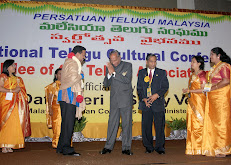
By SNV SudhirVisakhapatnam, Sep 5: The common thing apart the language that the Telugus in peninsula Malaysia have is that they all have their roots in the three north coastal Andhra districts. It’s surprising to know that most of the approximate 3 lakh Telugu populate staying in the country since five generations hail from Visakhapatnam, Vizianagaram and Srikakulam districts. Various researches done by some enthusiasts of Telugu speaking people in the country revealed the fact and every Telugu person in Malaysia strongly believe this. Indians constitute seven percent of the population with Tamilians in the lead followed by Telugu, Malayalam and Punjabi speaking people in Malaysia. “The slang used by the Telugus is of typical north Andhra Vizag style to indicate that most of them are from the same region” says Adari Appala Naidu, a 56 year old belonging to the third generation who born and brought up in Malaysia and currently residing in Kuala Lumpur. Naidu who held various positions in the ministries of Trade, Information and Prime Minister’s Office of Malaysia says that the immigrants to Malay who came to work in the rubber or palm plantations in the late 19th Century or early 20th Century hailed mostly from rural areas of north Andhra coastal districts. The lure of steady employment and possible riches in the far Malay pulled many illiterate agricultural laborers into becoming immigrants, says a research paper that was submitted by the Appala Naidu to the University of Malaya as part of his thesis work on sociology and development. He also presented this paper at the International Telugu Cultural Conference and Golden Jubilee of the Telugu Association of Malaysia held on from March 3 to 5, 2006 at Genting highlands in Malaysia. Speaking to this Correspondent from Kuala Lumpur Adari Appala Naidu said that he has been involved with the Telugu Association of Malaysia since his youth as his father was a Telugu school teacher and was the founder member of the Telugu Association which was formed in 1956. “I have attended many Telugu gatherings and meetings personally and know significant number of Telugus here. I have also been personally to most of the estates where Telugus have lived. During the course of meetings and discussions I got the knowledge that majority of Telugus originated from the Port city of Vizag and surrounding areas. I have also collected detailed statistics from the government of Malaysia about the immigrants,” said Naidu whose ancestors belong to Anakapalle. A research conducted by the Professor Emeritus of the Andhra University, Prof Eswara Venkata Gangadharam also says that most the Telugus migrated to Malaysia belonged to the North Andhra districts and embarked the British ships at the Baruva seaport in Srikakulam. “The two big poles near the shore at Baruva indicated that there was a sea port and according to the recordings of the oldtimers it was revealed that from 1895 to 1920 and 30 there was a huge embarkation from the seaport at Baruva.” said Gangadharam who did the research ‘Study of Baruva as departure port for migrants of Malaysia’ as part of the UGC project named “Maritime history of Andhra Pradesh 2002-05”. Apart from the roots another interesting thing is that the Telugus done a lot to preserve the language. Telugu is taught as "Peoples Own Language" (POL Classes) up to the secondary school level in areas where Telugus predominantly live. At present there are two government schools where Telugu is taught and they are located at Bagan Datoh area. At the secondary school level, a class to teach Telugu is organized if more than 15 students demand teaching of Telugu as a subject. Telugu is not taught as a subject at the University level. The fourth generation Telugus excelled in education, and was well endowed with better living and educational conditions. This is a proud generation for Telugus in Malaysia. “With the fourth generation, we can easily say that there are an estimated 500 Doctors, 250 lawyers, 250 Engineers, 150 IT graduates and another 2000 with degrees in various fields. The fourth generation Telugus though have progressed academically and financially, it cannot be denied that their love and allegiance towards their language and culture is not as intense as the first, second and third generation of Telugus. We do not see the fourth generation Telugus participating in Telugu activities with such enthusiasm as the previous 3 generations,” said Appala Naidu. This is partly because of their up-bringing in urban multi-racial environment. Added to this, urban living had not provided many opportunities for Telugu gatherings except at marriages and some Telugu Association functions, Naidu lamented. “It is now a great challenge for Telugu association to bring the fourth generation educated Telugus to their fold and make them members and leaders of the Association and ensure they speak and read Telugu and appreciate their own language and culture” says Appala Naidu. There were also others like D V Sreeramulu, ex secretary general of the association and Mrs Buloka Rao Didi and many others also strongly believe that they all have their roots in north Andhra. “I wonder how Telugus who have migrated to Malay four generations ago kept the Telugu language alive and at the same time I wonder how the Telugu speaking people in America are unable to come to grips about teaching Telugu to their children” said Dr Satyanarayana Gavarasana whose article “Telugu in Malaysia” published in the ‘America Bharathi’, Magazine of American Telugu Association. “My fore fathers are also from Gopalapatnam in Vizag. And most of us are from Vizag and surrounding areas only” said Adduri Venkatesulu the Vice President of the Telugu Association of Malaysia. The Telugu Association of Malaysia (TAM) has also embarked on an ambitious project to construct a Telugu Saamskruthika Nilayam in an area covering 2.5 acres, located north of Rawang town to preserve the Telugu language and culture in Malaysia.
Posted by SNV Sudhir at 2:47 AM

4 comments:
mycurries said...
Thank you so much for writting some interesting facts about Telegus of Malaysia.Somu Naidu was one of the 2 founding members of Andhra Association of Malaysia which was subsequently changed to Telegu Association of Malaysia.He was also the Secretary General for many number of years.To learn more and see Andhra Govt recognised his valuable contributions.Check...Source: The Hindu (http://www.hinduonnet.com/2007/06/03/stories/2007060308080400.htm)Andhra PradeshMe being the first Telegu launching world's first social networking site soon....Check www.oleworld.comDr Radha Krishna.
August 17, 2008 2:29 AM
Karl Naidu said...
My Late Grandfather Mr. Kuppen Gurusamy Naidu (K.G.Naidu) was the"Commissioner for labour Johore" During the British occupation and Japanese Occupation. He left Malaysia and when back to Andhra after Independence.He was friends with the Sultan of Johor and was a very well respected man.
August 22, 2008 3:58 AM
SCM Guru said...
I am thrilled to read this. Below is an interaction that I had with a Malay Telugu, which all Telugu's must read to feel proud of Malay Telugus for keeping the language alive even after 5-6 generations.In one of my visits to Singapore I met this telugu speaking waiter at Komala vilas hotel on Sarngoon Road. His name is Appa Rao. During the conversation I could never realize that he is a citizen of Malaysia and never visited India, his Telugu was so pure and of the Viznaaram accent. It was only when we were leaving, he mentioned that he is from a place called Telugasan in Malaysia (which I could not find on internet) and he doesnt know from where his fore-fathers hailed from.My excitement further grew when I heard this as his Telugu is as pure as the Telugu from Vizag, Vizianagaram area. Then I told him that his fore-fathers must be from Vizag, Vizianagaram area as his telugu accent is at lest 15+ year old accent of that area (which by now must have changed a lot).I am grately
November 2, 2008 4:39 AM
SCM Guru said...
just to complete me previously posted comment.I am greatful to the leaders like Mr.Naidu for their great support this ancient langauge which I love.
November 2, 2008 4:40 AM
Post a Comment

Thursday, June 4, 2009

Telugu Population Census

Telugu Population of Malaysia Kod 65

The population census of Malaysia is being carried out once in every ten years. The last census was carried out from 5/7/2000 till 20/7/2000. Next population census exercise would be carried out possible during the month of June/July 2010 throughout the country. During this period, census officers would call at every household for the purpose of interviewing and obtaining detailed data such as racial origin, language spoken, religion, number of people in each household, their ages, educational qualifications, occupation, type of school attended by children etc.

Basically thus information is obtained by the Government to shape Government policy, from time to time as the benefit and uplifting of the standard of the people of Malaysia.

Past experience has shown that as Telugus and Tamils are look alike there are many occasions we are recorded as Tamils.

As we, Telugus living in Malaysia must explain to the census officers to ensure that Telugus are recorded as Telugus in the Census Form: Telugu Kod 65. If every Telugu irrespective of whether a member or not member of Telugu Association of Malaysia must play his or her role firmly during the census exercise being done. That will prove to the Government the correct Telugu population and strength of the Telugus in this country.

If fact this is very important and pass this message on to all Telugus you meet so that they will be well aware of their rights by the time the Census begins.


Enkatesulu Juval
Ex Vice President/ General Secretary
Telugu Association of Malaysia.

Wednesday, May 27, 2009

Klang branch Silver Jubilee Celebration


Telugus from Klang get together for Silver Jubilee Celebration
It is on 28th February 1982 that I took the initiative to gather some of the Telugus living around Klang namely Suba, P. Seethapathy, Bala T. M Appalasamy, Marinaidu,U.S Appalanaidu, V. A.Chinniah, Dr Nanda Gopal,Nookaraju,Mahaletchimi,Apparao,A Sarojini, R. Ramanaidu,Nararayan Naidu, M Dorarajah,Nageswara Rao,P. Jegadesan,Garava Sooria Demudu,B K Sinniah and T PremaLatha Naidu to form a protem committee of the Klang Branch. The first protem committee meeting was held at Suba Optical Jalan Datuk Hamzah, Klang.

On 31/8/2007, the Klang branch of the Telugu Association of Malaysia celebrated its 25th Silver Jubilee in a grand manner at its newly purchased building at Bandar Baru Bukit Tinggi, Klang.
The new building named Telugu Thalli Bhavanamu was officiated by the Telugu Association of Malaysia president Dr Achaiah Kumar Rao on Merdeka Day.
Apart from special prayers and bhajans, other interesting activities were also organised during the celebration and top students were awarded for their good results for 2006 in UPSR, PMR, SPM and STPM examination.

Telugu dance performance was among the items during the cultural night. Subsequently they also had their dinner and cultural show where the crowd was entertained to Telugu songs and dances. More than 650 people were mesmerised by the exciting performances of local artistes and also the members of the association.
Dr Achaiah who was also present at the dinner congratulated the Klang branch committee members for their commitments and hard work for the past 25 years. Dr Achaiah Kumar Rao officiating the celebration at the new building by lighting the kutuvilaku (traditional Indian light).
There are about 10,000 Telugus living around Klang, Shah Alam, Port Klang, Banting and Kapar who still maintained their tradition, culture, language and celebrate Telugu festivals such as Sankranthi, Pethalla Pandukha, Ugadi, Sri Rama Navami, Bholokama Panduga, Gookula Asthami, Dhasarath Brahma Utsvam

Saturday, April 18, 2009

Great Telugu Spiritual Guru - Sai Baba


Sathya Sai Baba addresses his devotees in his native(mother tongue) language Telugu.

Sathya Sai Baba, born Sathyanarayana Raju on November 12, 1926 [1][2] with the family name of "Ratnakaram",[3] is a controversial South Indian guru, described by his followers as a godman and miracle worker.[1][4][5] The Sathya Sai Organization reports an estimated 1,200 Sathya Sai Baba Centers in 114 countries worldwide.[6] The number of Sathya Sai Baba adherents is estimated to be somewhere around 6 million, although followers cite anywhere from 50 to 100 million.[7] Followers consider him to be a reincarnation of the saint Sai Baba of Shirdi.

Sathyanarayana Raju was born to Peddavenkama Raju and Eswaramma in an agrarian family in the remote village of Puttaparthi, located in Anantapur district, Andhra Pradesh.[13] Biographer and devotee Schulman wrote in 1971 that "for any episode of Baba's childhood, there are countless contrasting versions and, at this point, the author discovered that it was no longer possible to separate the facts from the legend".

An official four-volume biography was written by devotee Professor Narayana Kasturi under the guidance of Sathya Sai Baba.The biography recounts an anecdotal incident where a cobra was found in the bedclothes of Sathya Sai Baba shortly after he was born.[16]. The book claims that the incident led to him becoming known as "lord of serpents" among the villagers.[2] Devotee Arnold Schulman contradicts the story, stating that Sathyanarayana Raju's sister who claims to have been present at his birth recounts the cobra was found outside of the house, several hours after Raju was born, a sight not uncommon in the village.[17] The young Sathyanarayana, the biography claims, was a vegetarian and was "known" for his aversion to animal cruelty.

At the age of eight, Satynanarayana Raju attended higher elementary school in Bukkapatnam. After that he joined another high school at Uravakonda. The biography claims that on March 8, 1940, Satynanarayana Raju started behaving "as if a scorpion had stung in his foot". He exhibited strange behavior after this and entered a coma state. After some time, he got up and his behavior worried his parents - he did not want to eat but, the biography claims, kept silent for a long time, and some times "recite verses". In May 1940, he proclaimed himself to be a reincarnation of the fakir and saint Sai Baba of Shirdi (d. 1918) and subsequently took the fakir's name, Sai Baba.[19] Baba purportedly taught them his bhajans (devotional songs that are sung out aloud in praise of minor Hindu deities or in praise of sai baba himself). Sai Baba claimed himself to be an "avatar". Sathya Sai Baba is listed in the 1942 school record of Bukkapatnam.[20] In 1944 a mandir for followers of Sathya Sai Baba was built near the village which is now called the "old mandir"(old temple).[18][21] The construction of Prashanthi Nilayam, the current ashram, was started in 1948.

In 1958, Sanathana Sarathi, the official magazine for the followers of Sathya Sai Baba, was published for the first time.

Sathya travelled only once outside India to visit North East Africa in 1968.[21]

Sathya Sai Baba had two sisters, one older brother (the late Seshama Raju) and a younger brother (the late R.V.Janaki Ramaiah).

Sathya Sai Baba established three temples (referred to as a "mandir") in India. The first center, established in Mumbai, is referred to as either "Dharmakshetra" or "Sathyam". The second center, established in Hyderabad, is referred to as "Shivam". The third center, established in Chennai, is referred to as "Sundaram".

Sathyanarayana Raju has been confined to a wheelchair since 2005 and reportedly his failing health has forced him to make fewer public appearances.


According to the Sathya Sai organization, Sathyanarayana Raju has written several articles on religious topics, later collected by the trust in the form of books, titled "Vahinis" (vehicles).[citation needed] There are sixteen vahinis.

Sai organization claims to advocate five values: sathya (truth), dharma (Hindu word for right conduct), ahimsa (non-violence), prema (love for God and all his creatures)[29] and shantih (peace).

Other teachings are:

Service and charity (seva) to others.[30]
Love for all creatures and objects.[30]
Putting a ceiling on one's desires is sadhana.[30]
Celibacy after age of fifty.[30]
Vegetarianism[29], moderate and sattvik diet.[30]
Abstinence from drinking alcohol,[30] smoking cigarettes,[30] and taking drugs.
Meditation (dhyan).[30] Baba teaches four techniques: repetition of the 'name of God'( "Sai" or "Sai Baba") ,[30] visualizing the form of God(often on sai baba's physical form),[30] sitting in silence, and jyoti (Flame/Light meditation).[30]
Importance of bhakti (devotion) to Sai Baba.[30]
Developing "prashanti"( vaguely translates to carefree-ness) and eschewing vices of character.[30]
Japa (ritual chanting of Baba's name) and other sadhana (spiritual exercise) to foster devotion.
Highly committed devotees use the phrase "Sai Ram" as a salutation.[30]
Conducting pooja or aarti( a form of ritual worship) twice daily in front of Baba photos.[citation needed]
At the ashram frequent "yagnas" or ritual worship involving ritual sacrifices of vegetable matter and ghee to a pyre is conducted for the baba.[30]

Ashrams and mandirs

The daily program at Sathya Sai Baba's temples usually begins with the chanting of "OM" and a morning prayer (Suprabatham). This is followed by Veda Parayan (chanting of the Vedas), nagarasankirtana (morning devotional songs) and twice a day bhajans and darshan (baba walks around or is wheel-chaired around amongst the gathered devotees) [52] Particularly significant are the darshans during October (the Dasara holidays and November (the month of Sai Baba's birth). [52] During darshan Sathya Sai Baba walks among his followers and may interact with people, accept letters, "materialize" and distribute vibhuti (sacred ash) or call groups or individuals for private interviews. Interviews are chosen solely at the Sai Baba's discretion.

Followers consider it a great privilege to get an interview and sometimes a single person, group or family will be invited for a private interview. It is claimed by the Sathya Sai Organization that meeting him has spiritual benefits.[53]

Some famous sayings of his are, "Help ever, Hurt never" and "Love all, Serve all'

Notable Telugu People

This is a a list of notable Telugu people.

TELUGU PRIME MINISTER AND PRESIDENTS OF INDIA.

Prime Minister of India

Shri P.V. Narasimha Rao June 21, 1991 - May 16, 1996

4 out of 12 Presidents of India

Dr. S. Radhakrishnan May 13, 1962 - May 13, 1967
Dr. Zakir Hussain May 13, 1967 - August 24, 1969
Shri Varahagiri Venkata Giri August 24, 1969 - August 24, 1974
Shri Neelam Sanjiva Reddy July 25, 1977 - July 25, 1982

Historic artists
Nannayya
Tikkana
Yerrapragada
Bammera Pothana
Allasani Peddana
Nandi Timmana
Tenali Ramakrishna
Poet Vemana
Sreenathudu
Sri Pothuluri Veerabramhendra Swamy
Sidhendra Yogi- Originator of Kuchipudi

Royalty
Gouthami Putra Satakarni -- Satavahana dynasty
Pratapa Rudra Raju -- Kakatiya dynasty
Rani Rudrama Devi -- Kakatiya dynasty
Vijay Rama Gajapati Raju Pusapati -- Vijayanagaram
Krishna Deva Raya -- Tuluva dynasty of Vijayanagara

Music composers
Tyagaraja
Shyama Shastri
Annamacharya
Bhadrachala Ramadas
Mangalampalli BalaMuraliKrishna
Movva Kshetrayya
Kandarpa Subbarao Avadhani
late pandit Kandarpa Subbarao Avadhani was born in mandapeta RAJAHMUNDRY AP Hethen left to pune to learn music from ustad ABDUL KARIM KHAN AND PT VINAYALK RAO PATWARDHAN HE WAS PROFESSOR OF MUSIC IN BHU VARANASI HIS EXPERTISE IN TARANA was MAIN ATTRACTION AMOUNG AUDIANCE HE DIED IN 1997 INVARANASI my grand father was pt bramanand sastry was a rajpurohit in peethapuram palace of rajahmundry his late wife lakshmi kantam is no more in this world only dreams are with us pt Vinayak Rao Patwardhan was great classical vocalists of india he was also great music legends of india .one of his best student late pt K S Avadhani learned and dedicated his life to music lovers he beacame music teacher in BHU varanasi and he also created Omkar Mahavidylaya in Faizabad see murlikrishna orcut album

Religious leaders and philosophers
Acharya Nagarjuna - Philosopher and Alchemist
Yogi Vemana- Poet and philosopher
Jiddu Krishnamurti - 20th century spiritual teacher and philosopher
Viswamji
Sri http://en.wikipedia.org/wiki/Sringeri_Shankaracharya
Sri Nimbarkacharya- One of the four principal Vaishnav acharyas of India.
Sri Vishnuswami- One of the four principal Vaishnav acharyas of India.
Sri Vallabhacharya- Another major Vaishnav acharya.
K.A. Paul - Christian minister
Sri Satya Sai Baba - An internationally renowned Spiritual Master, based in Puttaparti
Sri Pothuluri Veerabrahmendra Swamy - Clairvoyant
Sri Govindha Swamy - Founder of Aalaya Darshanam (Complete Information on Temples in India)

Warriors, martyrs and freedom fighters
Alluri Sitaramaraju
Potti Sreeramulu
Colonel D.S.RAJU
Tanguturi Prakasam
Pingali Venkayya
Prof. N.G. Ranga
Durgabai Deshmukh
Bhogaraju Pattabhi Sitaramayya
Sarojini Naidu
Kandukuri Veeresalingam
Major Padmapani Acharya
Scientists
Dr.A.V.Rama Rao
Dr.M.V.Rao
Dr.D.R.Rao
Yellapragada Subbarao
C. R. Rao
Y. Nayudamma
Prof. V. Ramalingaswami
Dr N.G.P Rao

Writers
Dr. Mahidhara Nalini Mohan Rao
Education
Dr C.R Reddy, Founder and Vice-chancellor of Andhra University
Krishna A Maddipatla (MK Anil), President & CEO, Maddipatlas Inc., New York and Director, NY State Education Dept for Vocational Schools
Dr K .Murali Krishna libraian RAU Jobner jewel of india
Award winners

Member of the British Empire
Dr. Sekhar Tam Tam 2006[1]

Bharat Ratna
V.V. Giri, awarded 1975
Dr. Sarvepalli Radhakrishna, awarded 1954

Padma Vibhushan
C. Narayana Reddy
Dr. P. Venugopal
Kaloji
Nandamuri Taraka Rama Rao
Prof.V. Ramalingaswami

Padmabhushan
Akkineni Nageswara Rao
Dr. B V Raju
Jaggayya
Koduri Iswara Varaprasad Reddy
Chiranjeevi
Shri Adusumalli Radha Krishna
Dr. Cingireddy Narayana Reddy
Shri Vavilala Gopalakrishnaya
Prof. V. Ramalingaswami
Rajiv Gandhi Khel Ratna Award
Karanam Malleswari - Weightlifting (1995-1996)
Pullela Gopichand - Badminton (2000-2001)
Arjuna Award
Sania Mirza (Tennis)
Mohammad Azharuddin (Cricket)
Karanam Malleswari (Weight Lifting)
Mithali Raj (Cricket)
V.V.S. Laxman (Cricket)
Koneru Humpy (Chess)
Achanta S. Kamal (Table Tennis)
Mukesh Kumar (Hockey)
Mulini Reddy (Volleyball)
Abdul Basith (Volleyball)
M. Shyamsundar Rao (Volleyball)
A. Ramana Rao (Volleyball)
P.V. Ramana (Volleyball)
Ravikanth Reddy (Volleyball)
m.ganesh(volleyball)
Yousuf Khan (Football)
J.J. Shobha (Atletics)
Anil Krishnan (Rowing)
M. Srinivasa Rao (Physically challenged - Badminton)

Democratic India politicians
Late Shri. Neelam Sanjiva Reddy - ( President of India)
Late Shri. Sarvepalli Radhakrishna - President of India
Late Shri. Tanguturi Prakasam - Chief Minister of Madras Presidency and First Chief Minister Of Andhra State.
Late Shri P. V. Narasimha Rao - Prime minister of India (1991-1996)
Late Shri. Varahagiri, Venkata Giri - ( President of India)
Late Shri. N.G. Ranga - Guinness Book of World Records
Late.Shri. Nandamuri Taraka Rama Rao, NTR - Chief Minister
Late.Shri. Kasu Brahmananda Reddy - Maharastra Governor, Chief Ministersec
Late.Shri. Kotla Vijaya Bhaskar Reddy - Chief Minister
Shri Nara Chandrababu Naidu - Ex-Chief Minister of A.P who brought I.T Revolution to A.P
Dr Kandarp Murali krishna MSc Phd NET SLET workinf as asstt librarian in rajasthan agricultural university jobner he has been awared jewl of india by indian soliderity council in new delhi 2006 for his outstanding achievemnt in his profession he has publsihed 35 reaserch articles in diffrent areas of education .he is writer.peot/painter educationist.geologist.librarian teacher scientists and many more hid father late K S aAvadhaniwas great vocalists of india born originally in mandapetta rajahmundry APS OF A

French Yanam
Monsieur Diwan Bouloussou Soubramaniam Sastroulou, (Ancien Membre du Conseil Local et Conseil Municipal de Yanaon, Ancien Jury De Yanaon, Former Diwan of Manyam Zamindari of French Yanam)
Monsieur Bezawada Bapa Naidou (Ancien Maire De Yanaon)
Monsieur Kamichetty Venugopala Rao Naidou (Ancien Maire De Yanaon)
Kamichetty Sri Parasurama Varaprasada Rao Naidu (Former MLA of Yanam for Six consecutive terms and Deputy Speaker, Speaker of Pondicherry)
Monsieur Dadala Raphael Ramanayya (Freedom fighter)
Monsieur Samatam Krishnayya (Poet and Pro-French Activist, Maire(interim) de Yanaon)
Monsieur Madimsetti Satianandam (Ancien Maire De Yanaon)
Monsieur Kanakala Tatayya

Wednesday, April 15, 2009

News from Newspaper 25/5/02

Online edition of India's National Newspaper
Saturday, May 25, 2002 Group PublicationsBusiness LineThe SportstarFrontlineThe Hindu

Southern States - Andhra Pradesh

Malaysian Telugus' plea to Naidu

By Our Special Correspondent


HYDERABAD May 24. The three lakh Telugus living in Malaysia feel culturally starved and look to their roots in Andhra Pradesh for help.

A large contingent of MLAs from Andhra Pradesh, which visited Kuala Lumpur earlier this month on a study tour, was given an affectionate welcome by the Telugu Association of Malaysia (TAM) at the Indian High Commission.

The Indian High Commissioner, Veena Sikri, said that Malaysia was home to the largest chunk of people of Indian origin, a good lot of them Tamils and Telugus.

The TAM was set up in 1955 and has 24 branches all over the country to serve the Telugus and boasts of a Sri Venkateswara temple in Perak. It is headquartered in a five-storeyed building in Kuala Lumpur while the Kedah branch is located in a three-storeyed structure. It has also set up a ``samkruthika nilayam'' at Rawang in Selangor.

K.M.N. Paul Naidu, president and Enkatesulu Juvalu, secretary-general, TAM, explained that the Telugus were handicapped by shortage of ``purohits'' to perform ceremonies as also good Telugu teachers. In a representation to the Chief Minister, N. Chandrababu Naidu, the TAM leaders sought allocation of seats for Malaysian Telugus in colleges and universities in Andhra Pradesh, particularly in professional and technical courses.

Qualified students were required to take examination again in Malaysia. The State Government may take the issue up with the Malaysian Government, it urged. Tamil Nadu had been able to sort out this problem.

The Telugu Association requested the State Government to send poets, writers, artistes and Telugu and English books on the language and culture, and students under cultural exchange programme

Telugu first

posts • Page 1 of 1
Chennai should be returned to Andhra Pradesh
by godman » Mon Sep,08, 2003 9:42 pm

Before independence, Chennai had more no. of Telugu people than Tamilians. What we feel is that Chennai should be returned to Andhra once again. What\'s your view? Be frank and come out please.godman
Registered User
Top
--------------------------------------------------------------------------------

Chennai should be returned to Andhra Pradesh
by pakka hyderabadi » Mon Sep 08, 2003 9:54 pm

Then where would the Tamilians go? In the Bay of Bengal? Give me your views. How can somebody get an idea like this?pakka hyderabadi
Registered User
Top
--------------------------------------------------------------------------------

Chennai should be returned to Andhra Pradesh
by Ramesh » Mon Sep 08, 2003 10:56 pm

I too agree with Pakka Hyderabadi. But the views can be expressed in a softer way. I don\'t think there\'s any requirement for Chennai as far as the people of AP are concerned. We have Hyderabad, and we can make it greater and more valuable than Chennai. That\'s the kind of spirit we need to have. We already had a very big bargain and that is the Tirupati temple. Even now the Tamils will be jealous about it and want it \"annexed\" by Tamil Nadu. But of course, it is ours.Ramesh
Registered User
Top
--------------------------------------------------------------------------------

Chennai should be returned to Andhra Pradesh
by Mayavi Morpheus » Tue Sep 09, 2003 12:13 am

Do you know that Chennai had 96% Telugu population before independance, but the Andhra Govt. (not AP govt) decided to have Tirupati in favour of Chennai as Tirupati brought more revenue to the state [The choice was either Tirupathi or Chennai, not both]? Also, we already had one big city - HYDERABAD and there was no need for Chennai.May the Fries be with you!Mayavi Morpheus
Registered User
Top
--------------------------------------------------------------------------------

Chennai should be returned to Andhra Pradesh
by a proud indian » Tue Sep 09, 2003 8:21 am

Ever heard of \'kaamnahin so kukdi kaajal pakdi\'? Chadvu ko ra naana ani school ki panpisthe evaritho ellla tagaadalu pettukovali anedi nerchukoni vachava, godman? Hey, c\'mon, leave all these issues of separate Telangana, and let\'s have Chennai to ourselves, etc etc. What you have, make the best use of it and make them work better for you, yaar! Why waste so much money, time and what not on these issues? Instead, let\'s use these resources along with all this passion and energy to better what we have. Let\'s unite as Indians rather than a Telangana, a Brahmin, a BC, an SC, ST or whatever! We are Indians, let us be so.a proud indian
Registered User
Top
--------------------------------------------------------------------------------

Chennai should be returned to Andhra Pradesh
by ENKATESULU JUVALU » Fri Sep 19, 2003 1:07 pm

Unnecessary issue but there are things that the Telugus ought learn from them. For them everything is Tamil, i.e. Mother is Tamil, milk is Tamil, land is Tamil. Even though Telugus are more than the Tamil in India, and outside India. Tamil is more known/used than Telugu, i.e. BBC has no Telugu news. On the internet the word mother is not in Telugu but in Tamil. Yes, it is in many more aspects too the same.

Let\'s speak more Telugu, print our call cards/pamphlets/leaflets etc. in Telugu too and be more united.

Jai Telugu Thali! Be proud. Telugu first, then an Indian.


Enkatesulu Juvalu, Malaysia.ENKATESULU JUVALU
Malaysia
--------------------------------------------------------------------------------

Chennai should be returned to Andhra Pradesh
by Andhraite » Fri Sep 19, 2003 2:30 pm

I don\'t agree with you friend. I\'m INDIAN first, then a Telugu!!! If every one thinks the way I feel, then there will be less casteism, racism, and regionalism. That\'s the way I like it.Andhraite
Registered User
Top
--------------------------------------------------------------------------------

Chennai should be returned to Andhra Pradesh
by peeping tom » Sat Sep 20, 2003 6:15 pm

I am sorry Mayavi, but the Telugu population in Chennai was 98%, not 96% as mentioned by you.peeping tom
Registered User
Top
--------------------------------------------------------------------------------

Chennai should be returned to Andhra Pradesh
by raju » Sat Sep 20, 2003 6:18 pm

Any idea what the Telugu population in Hyderabad is these days?raju
Registered User
Top
--------------------------------------------------------------------------------

Chennai should be returned to Andhra Pradesh
by Ravi » Sat Sep 20, 2003 7:41 pm

Down the line we do not know whether Hyderabad will be with Andhra or Telengana or will it be a common capital like Chandigarh. Forget about Chennai!Ravi
Registered User
Top
--------------------------------------------------------------------------------

Chennai should be returned to Andhra Pradesh
by raju » Mon Sep 22, 2003 7:55 pm

I think very soon we need to ask Pakistan also to give Karachi and Lahore back to us. Let them keep the Northern Frontier which will be no good to us (it is full of crazy terrorists).raju
Registered User
Top
--------------------------------------------------------------------------------

Chennai should be returned to Andhra Pradesh
by Mayavi Morpheus » Tue Sep 23, 2003 2:21 am

I am planning to ask US for its entire territory. Columbus set out to find India and found America instead. So, logically US should belong to India as he thought it was India.May the Fries be with you!Mayavi Morpheus
Registered User
Top
--------------------------------------------------------------------------------

Chennai should be returned to Andhra Pradesh
by godman » Sun Sep 28, 2003 9:21 pm

20% Marwadis, 10% Punjabis, 20% Maharashtrians, 10% Bengalies, 10% Oriyas, 15% Telugus, 10% (Tamil+Malayalies), 05% Other Indians - this is more of a mysterious crowd.godman
Registered User
Top
--------------------------------------------------------------------------------

Chennai should be returned to Andhra Pradesh
by JustaLittleUnwell » Tue Sep 30, 2003 7:34 pm

Hi all, first time on this board. A little about myself - a Telugu who grew up in Chennai and belongs to a family that has been settled in Tamil Nadu for generations. However, I\'ve been living in Hyderabad for the last 10 years, and hence am entitled to the title \'Hyderabadi\' (I hope).

Regarding this discussion about \'returning\' Chennai to AP (returning within quotes, because normally it applies when a property goes back to its original owner, which is not the case here, as AP never owned Chennai), I\'m not sure if the premise is right that 96% / 98% of Chennai-ites were Telugu during independence. Probably they outnumbered Tamilians at some point in history. Yet, they are culturally very different from the Telugus in AP. They speak a language which no one can understand .

Extending this logic, Mumbai should get integrated with Gujarat, Delhi should become a part of Punjab and so on. I guess proposals like these may not find wide acceptance. I hope to be posting a lot of messages (I have a lot of time to kill ) and hope to make a lot of friends here.

Cheers!Life is what happens to you when you are busy making other plans - John LennonJustaLittleUnwell
Registered User
Top
--------------------------------------------------------------------------------

Chennai should be returned to Andhra Pradesh
by Raju » Wed Oct 01, 2003 10:22 pm

Hi Justa! Nnot one but 8 Crores of people in this world understand Tamil which includes India, Srilanka, Singapore, Malaisia, UK and USA. It is one of the most widespread in the whole world. Even the Hyderabad city has a population of 5 lakh Tamils who live peacefully.Raju
Registered User
Top
--------------------------------------------------------------------------------

Chennai should be returned to Andhra Pradesh
by Ashwin » Thu Oct 02, 2003 12:50 am

Hi All,

I have a question regarding the Open Universities in Hyderabad. I want to do a degree in Business. Will the degree from an open university have any value after graduation? Will it be equal to other Universities\' degrees?Ashwin
Registered User
Top
--------------------------------------------------------------------------------

Chennai should be returned to Andhra Pradesh
by » Thu Oct 02, 2003 12:51 am

Haha! Posted on WRONG BOARD. Sorry!Registered User
Top
--------------------------------------------------------------------------------

Chennai should be returned to Andhra Pradesh
by JustaLittleUnwell » Thu Oct 02, 2003 2:16 pm

Correction, brother. I never said no one understands Tamil. So your statistic about 8 crore Tamilians is probably redundant.

If you read my post carefully, you\'ll realize that I was referring to the Telugus from Chennai (just like myself), when I said they speak a language (i.e. their version of Telugu) which no one else understands.

Hope this clears the air up.Life is what happens to you when you are busy making other plans - John LennonJustaLittleUnwell
Registered User
Top
--------------------------------------------------------------------------------

Display posts from previous: All posts1 day7 days2 weeks1 month3 months6 months1 year Sort by AuthorPost timeSubject AscendingDescending

--------------------------------------------------------------------------------
Post a reply18 posts • Page 1 of 1

Return to The Hyderabadi Planet!
Jump to: Select a forum ------------------ General The Hyderabadi Planet! Of Hyderabad, For Hyderabad, By Hyderabad Local Problems/Issues Announcements Find Classmates / Old Friends Communities NRIs Special Interest Groups Human Relationships Dakhni-Mehfil - The Old World Hyderabad Creativity, Inc. The Site Comments, Feedback And Requests
Who is online
Users browsing this forum: Google [Bot] and 2 guests

Discussions The team • Delete all board cookies • All times are UTC + 5:30 hours Powered by phpBB | Sitemap
Time : 0.153s | 9 Queries | GZIP : On


Advertisers | Help | Contact Us | About Us | Submit An Event | Get Listed | Privacy Policy | Terms of Use | We're Hiring

© Copyright 1999-2009 LRR Technologies (Hyderabad), Pvt Ltd. All rights reserved. fullhyd, fullhyderabad and Welcome To The
Neighbourhood are trademarks of LRR Technologies (Hyderabad), Pvt Ltd. The textual, graphic, audio and audiovisual material
in this site is protected by copyright law. You may not copy, distribute, or use this material except as necessary for your
personal, non-commercial use. Any trademarks are the properties of their respective owners.

Telugu Senator

Malaysian Government urged to appoint a Telugu senator
Malaysia News.Net
Friday 27th March, 2009 (ANI)

Kuala Lumpur, Mar 27 : The Malaysian Telugu Association has asked the government to consider appointing a senator from their community to highlight in Parliament the problems being faced by their community.

MTA president Dr Achaiah kumar Rao said the Telugus, who will be celebrating their new year today, had contributed much to the development of the country, Makkal Osai reported.

He added that the community subscribes to Astro, but were disappointed with the time allocated for them.

Dr Achaiah kumar Rao further said that they would submit a memorandum to Information Minister Ahmad Sabery Cheek urging for additional time for the Telugu community on Minnal FM, the Tamil-based radio programme on RTM.

TELUGU PEOPLE

Telugu people
From Wikipedia, the free encyclopedia
Jump to: navigation, search
Telugus

Telugu people:
Saint Tyāgarāja • Sarvepalli Radhakrishnan
• P. S. Kumaraswamy Raja • Tanguturi Suryakumari • Neelam Sanjiva Reddy • N.T. Rama Rao • Jiddu Krishnamurti • Sameera Reddy • Pullela Gopichand •
Total population
75,000 000[1]

Regions with significant populations
India
Malaysia 103,000
France 10,000
South Africa
USA
Australia
UK
Canada
Myanmar largest Burmese Indian group [2]

Languages
Telugu
Religion
Hinduism · Islam · Christianity · Buddhism · Judaism
Related ethnic groups
Dravidian · Brahui · Gondi · Kalinga · Kannadiga · Malayali · Tamilian · Tuluva
Telugu people refer to the group of Dravidian people who natively speak the Telugu language. They are one of the most ancient ethnic groups found in India, existing prior to the writing of the Vedas and mentioned in the Ramayana and Mahabharat epics. They are also the largest of the Dravidian groups by population and Telugu, which falls in the central Dravidian language group, is the most spoken of the Dravidian languages and the third most commonly spoken language in India after Hindi and Bengali.They are spread throughout India and abroad but the state of Andra Pradesh is their homeland. The most significant populations outside of Andhra Pradhesh are found in Pondicherry, Tamil Nadu, Karnataka, Maharashtra, Chattisgarh and Orissa.

Countries in North America, Europe, Africa, Australia, Mauritius, Fiji, Réunion and Malaysia also have significant populations. In the Americas they have two large associations called TANA [1] (Telugu Association of North America) and ATA [2] (American Telugu Association).

Contents [hide]
1 History
1.1 Andhra/Kalinga
1.2 Ancient Territory
1.3 Satavahanas
2 Language
3 Culture
3.1 Literature
3.2 Food
3.3 Traditional Dress
4 See also
5 References
5.1 External links


[edit] History

[edit] Andhra/Kalinga
Telugu/Andhra/Kalinga refers to the branches of the same Dravidian people. They were also called Andhri.[3] In certain times they ruled over Magadha, Anga, Asmaka, Mulaka and Kalinga.[4][5][6][7][8]

They are also mentioned in the Vayu and Matsya Purana.[9] In the Mahabharata the infantry of Satyaki was composed of a tribe called Andhras, known for their long hair, sweet language, and mighty prowess.[10] They lived along the banks of the Yamuna river. Andhras and Kalingas supported the Kauravas during the Bharata war. Sahadeva defeated the kingdoms of Pandya, Dravida, Odhra, Chera, Andhra, and Kalinga while performing the Rajasuya yajna. Chanoora was killed by Krishna in Madhura. Hari Vamsa Purana corroborates the fact that Chanoora was the king of Karoosa Desa (on the north side of Vindhya and on the north banks of the Yamuna river) and was an Andhra. Buddhist references to Andhras are also found. [11]


[edit] Ancient Territory
Andhras were nomads for several centuries. Some tribes migrated and others did not and remained in their older settlements. Apastamba Rishi states that around 700 BC some Andhra tribes inhabited Salvadesa on the banks of the Yamuna River. Apastamba sutra has been widely practiced among Andhra Brahmin families and continues to be followed even today. A single Rishi was the teacher (acharya) of each tribe. Apastamba was one such teacher. Apastamba wrote these rules in Salva Desam on the banks of Yamuna river. After Apastamba's death the Andhra tribes crossed the Vindhya mountains, reached the south, and merged with the other Andhra tribes. Atreya Brahmana tells us that Andhras lived on the south side of Vindhya along with Pundra, Pulinda, Sabaras, Mootibas.

Some of those Andhras who came to the south settled on the west side of Vindhya mountains (present Northern regions of Hyderabad). Another tribe crossed the Eastern Ghats over Orissa and reached the Kalinga Desam. Serivanijo Jataka tale explains that Andhras built the Andhaka-puram on the banks of Tel river.

Jataka tales were written during 200-250 BC. Tel river is a subriver of Mahanadi in Orissa. The people in this tribe are Kalingas. The books cited above describe the Andhras and Kalingas as two different branches of a single tribe. Sometimes these two words (Andhras and Kalingas) are used as synonyms.

Andhra tribes established relationships with Naga, Yaksha, and Dravida tribes of Vindhya mountains who already were living there. In Tamil and Kannada Ten means south side and Tenugu is a person travels to the south. The name Tenugu transformed into Telugu. From Telugu, words like Telagalu, Telangana, and Teligiri originated. A tribe called Tailang in Burma is proposed to be related to Telugu people.[3]


[edit] Satavahanas
The first great Andhra empire was that of the Satavahanas,[12] who came to power when the last Kanva emperor Sisuman, was assassinated by his prime minister Sipraca, of the Andhra tribe. They reigned for 450 years and the last was Puliman or Puloma the pious, who after conquering India put an end to his life by drowning himself in the holy waters of the Ganges, after the example of his grandfather. From this king, India was called by the Chinese Poulomeun-koue, the country of Puliman. While in the west the inhabitants of the Gangetic provinces were denominated Andhra Hindus[citation needed]. The Satavahana rulers are said to have been held in the highest veneration all over India[citation needed]; and their fame was extended to the peninsulas of Malaya, the Maharaja of India being a favorite subject of Malayan poetry[13].


[edit] Language
Main article: Telugu language
In Ancient times Telugu the language of the Andhras, seems to have been spoken as far north as the mouth of Ganges. This appears both from the geographic limits which the Greeks have assigned, to the territory of the Andhra race and from many of the names and places mentioned by Ptolemy up to that delta being found to be Telugu. Telugu is a name mentioned by the Greek geographers as that of a nation dwelling on or near the Ganges. In respect to antiquity of culture and glossarial copiousness, it ranks next to Tamil in the list of Dravidian Idioms, but this has been disputed as it has a large Sanskrit influence and has a different structure to that of other Dravidian languages. It is also named as the "Italian of the East" as most words in Telugu end in a vowel, as in Italian.


[edit] Culture

Kakateeya Sculpture at warangal
[edit] Literature
Main article: Telugu literature
Padya Sahithyam and Gadya Sahithyam
Bhagavatam by Sri Bammera Pothana
Ramayanam by Rayana Baskara
Ramayanam by Kummari Molla
Maha Bharatam by KaviTrayam (Nannaya, Yerrapragada and Tikkana)
Sataka Sahityam by Vemana, Baddena, Marana Venkana, Yenugu Lakshmana Kavi, Seshappa Kavi, Dhoorjati, and Bhakata Ramdas
Telugu Chatu Padhyalu
Tenali Ramalinga Kavi
Kavi Sarvabhouma Srinathudu
Telugu Vaggeya Karulu
Annamayya
Tyagaraju
Kshetrayya

[edit] Food

Ravva Dosa served at a Hotel in Guntur.Some common Telugu foods are:

Paravannam
Aavakaaya Pachadi
Maagaya Pachadi
Chintakaya Pachadi
Gongoora pachchadi
Korivi Karam
Vankaya Kura
Pootha Rekulu
Madata Kajalu
Gor Meetilu
Ariselu
Boorelu
Gaarelu
Bobbatlu (bhakshaalu in Rayalaseema)
Jentikalu
Chakkilaalu
Ulava Chaaru
Pacchi Pulusu
Bommidaila Pulusu
Vadiyalu
Attu (dosa)
Pappu
Rasam
Charu
Sambaru
Pulihora

[edit] Traditional Dress

Uma Muralikrishna, a very talented Kuchipudi dancer performing at IIM BangaloreMale
Uttareeyam (Angavastram or veil)
Jubba (Kurta) The top portion
Pancha (Dhoti)
Lungi (Casual or Worker dress)
Women
Cheera (Sari)
Girls
Parikini
Langa Oni (Half Saree)

[edit] See also
Satavahana Dynasty
Kakatiya dynasty - the first great Telugu kingdom that lasted for centuries
Vijayanagara Empire
List of people from Andhra Pradesh
Andhra Pradesh
List of Telugu people
Telugu language
Andhra cuisine

[edit] References
^ Top 30 languages
^ Kernial Singh. Indian Communities in Southeast Asia]]. p. 588. http://books.google.com/books?id=TeExjdWUmJYC&pg=PA915&d.
^ Ramanlal Chhotalal Mehta, Studies in Musicology, Indian Musicological Society (1983)
^ http://books.google.com/books?id=79w9AAAAMAAJ&q=andhra+race&dq=andhra+race&lr=&pgis=1
^ http://books.google.com/books?id=IfQQ6hWz37EC&pg=PA81&dq=andhra+race&lr=&sig=KDaZpybQCK1RL2-xnJTFdNSUzVM#PPA81,M1
^ http://books.google.com/books?id=GrUFAAAAIAAJ&pg=PA33&dq=andhra+race&lr=#PPA33,M1
^ http://books.google.com/books?id=x40BAAAAMAAJ&q=andhra+race&dq=andhra+race&lr=&pgis=1
^ http://books.google.com/books?id=-tpDAAAAIAAJ&q=andhra+race&dq=andhra+race&lr=&pgis=1
^ http://books.google.com/books?id=9PdzBZegtvMC&q=andhra+race&dq=andhra+race&lr=&pgis=1
^ http://books.google.com/books?id=EmIMAAAAIAAJ&pg=RA2-PA20&dq=andhra+race&lr=
^ http://books.google.com/books?id=wRAhAAAAMAAJ&q=andhra+race&dq=andhra+race&lr=&pgis=1
^ http://books.google.com/books?id=Sae4q93tSGkC&q=andhra+race&dq=andhra+race&lr=&pgis=1
^ Josiah Conder, The Modern Traveller: A Popular Description, Geographical, Historical, and ... v. I, India, (1828), p.139

[edit] External links
Telugu People Social Network
anigalla.net
TeluguVedika.com
Vemana
Translations of Telugu fiction and articles
Telugu people profiles
VedaBooks
Retrieved from "http://en.wikipedia.org/wiki/Telugu_people"
Categories: Telugu people | Dravidian peoples
Hidden categories: "Related ethnic groups" needing confirmation | All articles with unsourced statements | Articles with unsourced statements since October 2008

Tuesday, March 3, 2009

Medical Education of Telugus of Malaysia

Medical Education of Telugus of Malaysia

Education has been the key foundation for all youths who are the future pillars of every society. It is very completive for the Malaysian Indians or Telugus to obtain entry into the local Malaysian universities. Many rich Malaysians Indians or Telugus secure a place in private colleges, which is very costly. But the Telugu youths who are generally from average earning families opt to work instead of pursing high education.

Malaysian Telugus who migrated to Malaya, then in the early 20th Century were mostly plantation workers in the rubber and coconut estates. Most of these Telugu immigrants were economically under privileged.

And since, the implementation of the donation policy, the medical fee and other related expenses has escalated to approximately RM350,000 for NRI/PIO’s residing outside India. The amount may be affordable figure for those from United States, United Kingdom or other forward countries. Unfortunately we, the Malaysia Telugus are unable to digest this kind of an amount for pursing higher education in India.

Here, we would like to take pride to say that in 60’s, 70’s and even 80’s it used to be common for the Malaysian Telugus students to purse his/ her medical degree in Andhra Pradesh or other parts of India.

Upon completion they returned as highly esteemed doctors and brought along the awareness and acquaintance of Telugu language and cultural heritage. I believe that the survival of the Telugu language, culture and tradition in Malaysia mainly depends on Andhra Pradesh.

Sadly today, due to the high cost of education in India we have lost or losing our Telugu students to countries like Ukraine, the Federation of Russia and Indonesia as it only cost average of RM170,000 for the entire course.

Since the year 2000 under the Reservation of seats allocated for the Telugu students of Malaysia with reference to the Health Medical and Family Welfare Department letter No 13434/E198-2 there has been only one Telugu student from Malaysia who pursed her MBBS degree at the Andhra Medical College, Visakhapatnam for almost RM200,000. But Goverment Order(GO) is not valid any more.

Telugu Community would like be glad if the Andhra Pradesh Government to grant us with five medical seats annual at any medical college which are recognized by the Malaysian government for nominal fee on about RM100,000.

Lately a number of Andhra Pradesh Medical colleges were recongised such as Andhra Medical Collage, Visakhapatnam, Kurnool Medical College, Guntur Medical College, Guntur, Gandhi Medical College, Hyderabad and all the while the Osmania Medical College was recongised by JPA and MMC Malaysia.

Telugu Association of Malaysia should take up the task of continuing to persuade the Andhra Pradesh government for allocation seats,annually.

Sunday, February 22, 2009

MY SMALL ROLE FOR TELUGU POL CLASSES

My small role for Telugu classes as Pupils own language(POL)

From 1968-1992 Telugu language was offered as an optional subject in LCE/PMR and MCE examinations in accordance to the Article 152(1)(b) of the Federal Constitution guarantees to teach or learn any other language. This goes back to the hard work of the Andhra Association of Malaysia(AAM)committee,then and to especially Sri M .D Somunaidu,General Secretary,then who serviced almost 25 years as General Secretary.

But it was strange that Telugu language classes were not conduct at any primary or secondary schools like Tamil and Chinese classes were conducted.

In 1971 when I was in Form 4 at SM Khir Johari, Sungai Sumun, Hutan Melintang, Perak.my school badminton partner Sri Naidu who is now living in Kuala Trengganu known as Risal Naidu and I made an attempt to see the Headmaster who was then En. Ismail bin ...... to allow the POL classes for Telugu language. But before we went to see Dr Iswar who was then was in Form 1 or 2 assisted to gather details of all Telugu students of the school then.

The Headmaster briefed us that there is no allocation or budgar or lot to allow teaching of Telugu language as POL. However, he promised us that he would write to the Education Departments concern.

Hence, in the 1972 the start of teaching POL classes begin for Telugu language around the country where ever there was request by at least 15 students/ parents for teaching Telugu POL classes.

AAM or later known as TAM was or is still encouraging Telugu students to take up Telugu classes.

With the beginning of Telugu POL classes, there were also other activities such as ‘Bahasa Telugu’ clubs and Ugadi celebrations were established in the schools. I believe one of the first chairmen of such club was Sri R. Krishnamorthy (MBF) for SM Khir Johari, Sungai Sumun.

Whereas, in the year of 2004, Telugu POL classes were denied in Kedah/ Perak states thus I have being the General Secretary of TAM, then wrote and followed up about the issue to the Education Department and other departments concerned until it was again sanctioned.

Again in the year of 2006, Telugu POL classes were denied in Perak state hence I did the follow-ups to the Education Department and other departments concern until it was again sanctioned.

We only ask our mother-tongue which was here prior to independence and after independence till 1992 to be reinstated in PMR/SPM examination so that Telugu language and culture will not be decimated. Loss of Telugu language and culture will be a dent to the rich cultural heritage of Malaysia.

So, by including Telugu language in PMR/SPM it will facilitate our efforts immensely and it will spur us further in the promotion of Telugu language and the students too will be motivated to take the subject.

Friday, February 20, 2009

Uniformity of Telugu spellings in English

There are a number of uniformity of spellings in English such as ie:-

i) Ugadi, Ugadhi, Ugathi, Ugadthi as Ugadi

ii) Telugu, Thelugu,Telegu,Thenngalu, as Telugu

iii) Shri,Sri, Shree, Sree Shri as Sri

Could be more of such words but We,Telugus should write one spelling of any one subject.

There should probably some Govt. Department from Andhra Pradesh to come out or if there is any such Glossary of Telugu spellings in English to be placed online for reference.

I did that when I was the General Secretary of Telugu Association of Malaysia
a "GLOSSARY OF MALAYSIA TELUGU SANGAMU" and some of it is as follows:


1 Bhogi ------ Eve / day before Saakranti festival
2 Sankranti ------ Harvest Festival/Makar Sankranti/Pongal
3 Ugadi ------ Ugadhi/Ugadthi/Ugathi/ Telugu New Year Day
4 Sri ------ Sree/Shri/Shree/Sri
5 Deepavali ------ Festival of Lights/ Diwali
6 Telugu ------ Thelugu,Telegu,Thenngalu,

Wednesday, February 18, 2009

TELUGU

Sunday, December 21, 2008
'Telugu must in all offices'

95 p.c. implementation in Nizamabad: Language panel chief
--------------------------------------------------------------------------------

Srikakulam, Chittoor districts placed second and third respectively

A.B. K. Prasad for steps to implement Telugu in full by February-end


--------------------------------------------------------------------------------


KADAPA: Nizamabad district is ‘numero uno’ in the State with a 95 per cent record in implementation of Telugu in all official correspondence followed by Srikakulam and Chittoor districts in the second and third place, Official Language Commission Chairman A.B.K. Prasad, said on Wednesday.

Four districts were implementing Telugu in official correspondence, Mr. Prasad told newsmen here. Quoting official claims, he said implementation of Telugu as official language was 66 per cent in Kadapa district and exhorted the officials to strive for increasing it to over 80 per cent.

Lauding district Collector M.T. Krishna Babu’s directive two days ago, to mandatorily forward all note files to him in Telugu, he said the official concerned responded positively though belatedly. The Commission would forward a report to the government suggesting action on districts which fail to enforce the official language.

The commission chairman complimented the district panchayat office for ensuring 85 per cent implementation of Telugu in its official correspondence. He lauded the efforts of Khader Basha, administrative officer in district panchayat office, though Telugu was not his mother tongue.

He advised other government departments in the district to emulate the district panchayat office.

Mr. A.B.K. Prasad was chief guest at the ‘Telugu Vikasam’ programme, a competition conducted for junior and senior assistants and supervisory staff in drafting note file in Telugu at Kalakshetram here.

British days
Addressing a meeting in the evening, Mr. A.B.K. Prasad recalled that British officers such as Charles Phillip Brown, Thomas Munroe and MacKenzie ensured all official correspondence in Telugu one-and-a-half century ago, for the understanding of the common man, but the penchant to use English has increased in recent times.

Official language was being effectively implemented in Tamil Nadu, Kerala and Maharashtra, but not so vigorously in Andhra Pradesh, he lamented.

Cautioning that lack of frequent use would lead to diminishing influence of a language, he said IAS and IPS officers should follow the stipulation of adhering to all correspondence in native language of any State within an year of their posting.

He wanted steps to ensure improvement in the implementation of Telugu by end of February. District Revenue Officer K. Madhusudan, said in his report, that implementation of official language was 81 per cent in Kadapa Collectorate and 82 per cent in the SP’s office, and the district average was 66 per cent. Efforts were on to draft land acquisition notices in Telugu, he said.

Poor implementation
The chairman lamented poor implementation of Telugu at 25 per cent in the Social Welfare and School Education Departments, 12 per cent in Annamayya project and five per cent in Galeru Nagari Sujala Sravanthi project.

The State government’s service rules, a dictionary and 10 other books would be released in Telugu soon, he said. He gave away prizes to winners of the note file drafting and elocution contests. Joint Collector M. Girijasankar, Zilla Parishad CEO Venkataswamy and DEO G.A. Hemanath, Yogi Vemana University Head of Telugu Department Rachapalem Chandrasekhar Reddy participated.


Courtesy: The Hindu

TELUGU...a language sweeter than honey

TELUGU - Italian of the East" - Niccolo Da Conti, 15th Century

"dESa bhAshalaMdu telugu lessa" - tuLuva rAju SrI kRshNadEvarAya
Telugu is the sweetest of all Indian languages - Great Tuluva Emperor Sri Krishnadeva Raya, 16th Century

"suMdara teluMgiL paaTisaitu" - SrI subrahmaNya bhArati
Let us sing in Sweet Telugu - by Tamil poet Sri Subrahmanya Bharati, 20th Century

Grim translation scenario not helping Classical Telugu

Telugu may have attained classical language status, but very few people will get to read any of its literary texts, if current translation trends continue. At present, translation of Telugu literary works is taken up sporadically, and that too only into English and not Indian vernacular languages.

In view of the recently accorded classical language status for Telugu and Kannada languages as well as the establishment of a Translation Mission of India, a ninth CLAI (Comparative Literature Association of India) biennial international conference being held at the University of Hyderabad acquires significance.

Speaking of the grim Telugu translation scenario, M Sridhar, a Telugu translator and professor of English in the University says, "Given a choice, people would prefer reading Adiga or Chomsky novels rather than Chaya Devi or Raavi Shastry. Texts and literature sourced from English are still perceived as windows to the world." Most other Indian languages face a similar situation, he added.

Market dynamics go against cross vernacular translations, so publishers and authors are also drawn to higher sales and wider exposure that English provides. Then there is the problem of publishers playing favourites when selecting the recipient language, with Kannada, Oriya and Bengali being popular languages.

"Translation can be an important medium of networking the country and also gives an insight into the linguistic heritage and shared values of different regions," says Tutun Mukherjee, head, department of Comparative Literature in the University of Hyderabad adding that the conference will also take up travel writing, literature of the marginalised, tribal literature, philosophy, religion and women's writing.

However, recent Central government grant of Rs 90 crores to the Mission towards translation of knowledge-based texts into 23 vernacular languages is raising hopes of translators.

Andhra Pradesh: 5 walled cities from 300 B.C. unearthed

Andhras flourished during the time of Chandragupta Maurya much before the advent of the Satavahanas, and were said to be as powerful as Mauryans. They had 30 fortified walled cities way back in 300 BC, wrote the Greek traveller Megasthenes in his Indika. In what could be an exciting discovery, the State Department of Archaeology and Museums has identified five of those 30 walled cities.

The Department has found physical evidence proving Megasthenes right and by the same token –– throwing light on the existence of Andhras and Telugu language before the Satavahana period. The study is part of a project taken up to find the 30 walled cities mentioned by the Greek traveller and historian in his travelogue.

‘‘Though the Andhras were mentioned in books dating back to 1,000 BC, we have physical evidence like coins and pottery only from the Satavahana period (200 BC - 200 AD). Our research based on Indika of Megasthenes strengthens the theory that the Andhras existed before the Satavahanas.

Excavation of these sites will provide more physical evidence on history, administration, language, customs and traditions of our ancestors,’’ said P Chenna Reddy, Director of Archaeology and Museums Department.

Megasthenes is believed to have visited India as an Ambassador of Seleucus I of Syria to the court of Chandragupta Maurya around 305 BC.

In Indika, Megasthanes indicates that the Andhra (mentioned as Andarae) kings belonged to a powerful race and possessed an army of 100,000 infantry, 2,000 cavalry, 1,000 elephants and had 30 well-built fortified towns.

With Telugu obtaining classical language status, the project assumes importance and is likely to give an insight into its origins and the historical existence of Andhras. The officials have so far examined 18 sites with historical importance and singled out five.

Archaeologists recovered bricks, pottery, coins and other evidence from these sites at Dhoolikatta, Kotilingala (both Karimnagar district), Satanikota (Kurnool district), Dharanikota (Amaravathi) and Bodhan (Nizamabad district).

The project was taken up in October, 2005 and efforts are on to identify the remaining Megasthanes towns in Andhra Pradesh as well as at a few places in Maharashtra, Karnataka, Chhattisgarh and Tamil Nadu.

copied from: Teluguanam.blogspot.com

Monday, February 16, 2009

Establishment of Andhra or Telugu Association of Malaysia Klang Branch

It is on 28th February 1982 that I took the initiative to gather some of the Telugus living around Klang namely Suba, P. Seethapathy, Bala T. M Appalasamy, Marinaidu,Ulu Appalanaidu, Sinniah, Dr Nanda Gopal,Nookaraju,Mahaletchimi,Apparao and T PremaLatha Naidu to form a protem committee of the Klang Branch. The first protem committee meeting was held at Suba Optical Jalan Datuk Hamzah, Klang

In fact, we invited Mr A. Appana Naidu who was then working around PM Department, Shah Alam to head the committee who later declined after one or two committee meetings as he was transfered back to K.Lumpur/KK. After which I headed the protem committee.

The Branch was registered on 23th April, 1982 and a new life was energized into the Klang Branch. And in 1983 as Andhra Association of Malaysia was renamed as Telugu Association of Malaysia for simple reason to allow Telugus who migrated from other states of India or any other countries besides Andhra Pradesh could also join the Association.

Upon this new rebirth the Branch took on many activities and it has progressed well to become a good concentration of many Telugus in the Klang/ Shah Alam area,then.

I was the first chairman of this 18th registered Klang branch from 1982 till 1986. Some remarkable activities were spearheaded by my committee and some of them as follows:-

In the same year Klang hosted Annual General Meeting of Andhra Association of Malaysia. It was at this Annual Meeting that the new name Telugu Association of Malaysia was tabled and passed besides the change of annual meeting to be conducted as Biennial Meetings. The Report and Accounts submission of Silver Jubilee Celebrations & 2nd World Telugu Conference held from 14 till 19 April,1981 at Civic Centre, Petaling Jaya was also done at this Annual General Meeting in Klang.

In the year 1983 - MIC Taman Gembira, Klang /Kerala Samanjam Klang Branch /TAM Klang branch jointly organised “Malam Nirava" culturely show.
Annually Ugadi Celebrations were done grand scale.

In 1984 a “Lucky Draw” Lottery was launched to raise funds for the purpose of buying a building for the Klang Branch. The event raised a good sum of RM 10,900 and it remained as a Building Fund in the Book Keeping Entries.

In 1985 the Branch helped Telugu Association Malaysia (TAM) headquarters to organize a dinner to honour MIC President, Dato Seri Samy Velu for his 50 years birthday at the Dewan Hamzah,Klang.

• Ugadi celebrations& Bhajans and devotional activities at members homes on rotation.
• Regular committee meetings to discuss on current issues at hand.
• Telugu classes conducted by Mr Rama(Banting)& Membership drives to gather new members.
• Get together sessions amongst members and members’ families.

Although the Klang Branch took its real active life form in 1982 onwards but we must not forget to mention there was this Andhra Association of Malaysia Klang District branch being officially registered on 22nd April 1971 with its official address at 759, Jalan Rasah, Pandamaran New Village, Port Swettenham, Selangor under chairmanship Sri Narayanasamy Reddy, PPM, PJK. At that particular time Sri Narayanasamy Reddy was a Chief Clerk at the Majlis Perbandaran Klang. However the earlier branch was deregistered on establishment Klang Branch.

When I was then the newly formed Klang branch chairman was one of those besides Dr. A C Apprao, then the President and Late R. P Ramulu then the General Treasurer who were involved in the preparation and approval of constitution and even shifting the HQ address from which was registered at N0 41, 25th mile, Bagan Datoh,Perak or Ipoh office (ROS)registration to Kuala Lumpur.

Besides, I was also able obtained permission from Ministry of Home Affairs(KDN newspaper permit) for circulation newspaper for Telugus in the Telugu/ English language for Nokiah Gary, then the Secretary General of TAM.

Last year after 25 years,Silver Jubilee Celebrations of the Klang branch were grandly conducted.

C. P. Brown, THE SAVIOR of TELUGU CULTURE

C. P. Brown, the Savior of Telugu Culture

British rule in Andhra had both positive and negative aspects.
On the positive side of the coin, we have eminent people like
Charles Philip Brown who rejuvenated the Telugu literature.

Charles Phillip Brown's father Reverend David Brown, a Christian
missionary, came to Calcutta in 1786. Reverend Brown learned several
Indian languages to understand the culture and religion. Charles
was the second son of Browns, born on November 10, 1798. The family
went back to England after the death of Reverend Brown. Charles
studied Sanskrit in college with an aim to work for East India
Company and obtained a gold medal in Sanskrit Studies. East India
Company sent him to Chennai (Madras).

Charles arrived in Chennai on 4th August 1817. At that time he
didn't even know that there existed a language and nationality
called Telugu or Andhra, just like anybody outside India even
today. He joined St. George College to learn Telugu from
Kodandarama Pantulu. He became proficient in Telugu within sixteen
months at the time when Telugu Pundits didn't know any English at
all.

In 1820 Sir Thomas Monroe came to Chennai as governor and
ordered that every official in the Company should be proficient in
the local language and perform their duties in the local national
language. (Compare the situation today: Many officials feel shy to
speak in Telugu in State government offices. Central government
officials have a right not to speak Telugu. Even the kirana merchant
in Hyderabad looks at you like an idiot villager if you speak in
Telugu. English or Hindi or Urdu works wonders in Hyderabad, the
Capital City of Telugus).

Charles started his career in Kadapa (Cuddapa) as an assistant
to the Collector, Mr. Han Bury. The collector used to speak very
fluent Telugu. (Many collectors in Andhra Pradesh today are non-
Telugus and don't speak Telugu at all.) Mr. Bury became the role
model for Charles. Charles tried to emulate him. Charles Brown
established two schools in Kadapa and arranged for free education in
Telugu and Hindi with Indian teachers. He arranged for free meals to
the school children. He also started two more schools in
Machilipattanam, with free food for students.

He got interested in Vemana's literature in 1824. He studied
Vemana's and other Telugu literature, and Telugu meter and grammar
under the guidance of Venkatasivasastri Tippabhatla and
Advaitabrahmasastri Vatthyam. Charles Brown was transferred to
Rajamundri in 1825. He continued his study of Telugu literature. He
collected the written scripts of Telugu Kavyas (poems) that were on
the verge of extinction. He hired some copyists/writers
(raayasagaallu) to prepare fresh copies. He reprinted Andhra
Mahabharatamu and Andhra Mahabhagavatamu. He found a shelter for
the destitute Goddess Telugu Saraswati and was able to redecorate
her like a married Indian woman.

He went to London on vacation (during 1835-38) and collected
2,106 hand written books in South Indian Languages from the India
House Library and sent them back to Chennai Library. He edited and
published several Telugu and Sanskrit books after he came back from
London. He collected sayings, stories, poems etc. that were popular
at that time among common population. He also wrote several grammar
books and learning materials for English people who were interested
in learning Telugu. Madras Oriental Library hoards several of C. P.
Brown works.

Charles Brown spent his own money for the development of Telugu
and even took loans for the same. He saved every penny for the
development of Telugu. Even in the tough financial times he didn't
give up his Telugu development programs. He retired in 1854 and
settled in London. He worked at London University as Telugu
Professor for some time. He died in 1884 on December 12 at the age
of eighty-seven. His selfless service to Telugus and their culture
and literature is unparalleled even among Telugus. Every Telugu
Indian should remember his services to Telugu culture and its
preservation.

Hanumachchastri Janamaddi says, "minuku minuku mantunna Telugu
waangmayadeepaanni snehasiktam chesi prajwalimpachesina
aandhrabhashodhdhaarakudu C. P. Brown." (C. P. Brown, the savior of
Telugu Culture and Literature, rekindled the dying lamp of Telugu
literature with his friendship and service.)

Tuesday, February 10, 2009

Constitution of Telugu Association of Malaysia

The Association was first formed in Lower Perak, Perak on 17th August 1955 under the banner of Malaya Andhra Sangamu. Subsequently it was renamed on 16th December 1963 to Malaysia Andhra Sangamu.

Later in the 1983, it was established as Persatuan Telugu Malaysia(PTM) and which otherwise also known as Telugu Association of Malaysia. This was done for the simple reason that could allow other Telugus besides who came from Andhra Pradesh to join the Telugu Association too.

From very first day when it was renamed, I was then the newly formed Klang branch chairman was one of them besides Dr. A C Apprao, then the President and Late R. P Ramulu then the General Treasurer who were involved in the preparation and approval of constitution and even shifting the HQ address from which was registered at N0 41, 25th mile, Bagan Datoh,Perak or Ipoh office (ROS)registration to Kuala Lumpur.

Even later when Mr B. Murthy then Deputy President/later President and myself then General Secretary later Vice President were involved when amendments were done two times which included another name as Malaysia Telugu Sangamu.

And it is during Sri B. Murthy as the President and I being the General Secretary that formation of Youths/Mahila(women) sections were formed and two Vice Presidents (one from Youth & one from Mahila)were appointed as allowed by the Constitution which is no more in pratice or followed.

As there has been requests off and on about the below, I believe this could the serve the purpose.

CONSTITUTION OF PERSATUAN TELUGU MALAYSIA

RULE 1 NAME AND ADDRESS
(i) The name of the Association shall be Persatuan Telugu Malaysia (MALAYSIA TELUGU SANGAMU) hereinafter referred to as the “Persatuan”
(ii) The registered address of the Persatuan shall be 9-1A. Jalan 1/64A, Off Jalan Ipoh, 50350 Kuala Lumpur, which shall not be changed without the prior approval of the Registrar of Societies.
(iii) The place of meeting of the Persatuan shall be at such a place as may be determined by the Central Executive Committee.
RULE 2 OBJECTIVES
(i) To promote, preserve and safeguard the Telugu Language.
(ii) To promote and safeguard the linguistic, educational, economic, social, cultural, spiritual and religious interests of the members.
(iii) To create a sense of solidarity and fraternity amongst the members of the Telugu Community as well as other communities in Malaysia.
(iv) The Central Executive Committee shall be authorized on behalf of the Persatuan to invest in any appropriate authorized and approved financial institutes or organizations including companies and co-operatives.
RULE 3 MEMBERSHIP
(i) Any Malaysian citizen of Telugu Origin who has attained the age of 18 years and who subscribes to the objectives of the Persatuan shall be eligible for membership either as an Ordinary or a Life Member.
(ii) Associate Membership which may be open to residents in Malaysia other than Telugu Malaysian citizens of at least 18 years old who subscribe to the objectives of the Persatuan.
(iii) Honorary Membership which may be conferred by unanimous vote of the Central Executive Committee on persons who have rendered distinguished services to the Persatuan.
RULE 4 ENROLMENT
(i) Application for membership or transfer of membership shall be made on prescribed forms and submitted to the Branch Secretary of the Persatuan nearest to the place of residence of applicant or to the Central Executive Committee.
(ii) All applications for membership shall be processed by the Executive Committee of the respective branches and submitted to the Honorary General Secretary with recommendations. The Central Executive Committee shall be vested with powers to approve or reject such applications. Where no branches have been established shall be dealt with in the same way by the Honorary General Secretary and the Central Executive Committee.
(iii) Copies of particulars of all new members enrolled shall be forwarded by the Branch secretary to the Honorary General Secretary of the Persatuan one (1) month before the Biennial General Meeting of the respective Branch on or before 31st March.
(iv) The entrance fees for all categories of membership shall be Ringgit Malaysia Ten (RM 10.00) per member to be submitted with the application forms to the Central Executive Committee Meeting or Central Working Committee Meeting.
RULE 5 SUBSCRIPTION
(i) The subscription for Ordinary Membership shall be Ringgit Malaysia (RM 20.00) for a biennial term and Life Membership Ringgit Malaysia Two Hundred (RM 200.00).
(ii) The subscription for Joint Life Membership for husband and wife shall be Ringgit Malaysia Three Hundred (RM 300).
(iii) The subscription for Ordinary Membership shall be for a Biennial term which expires by the end of 31st December of the following year. An Ordinary member who is in arrears of subscription for a period of three months after the expiry date shall cease to be a member.
(iv) The subscription for Associate Membership shall be RM 10.00 per annum.
(v) The subscription for Ordinary and Associate Membership shall be payable in full together with the application. All subscription fees are not refundable.
(vi) Any applicant for Life Membership who fails to pay the subscription in full within the 20 months shall forfeit any sum paid and in such event shall cease to be a member of the Persatuan. (vii) Special subscription or levies for particular purpose may be raised from members by resolutions of the Biennial Delegates Conference.
RULE 6 RESIGNATION OF MEMBER
Any member who wishes to resign from the Persatuan shall give two weeks notice in writing to his/her Branch Secretary and shall pay up all dues. In such event he/she shall not be entitled to any benefits and or refund of any money paid by him/her to the Persatuan.
RULE 7 PRIVILEGES OF MEMBERS
(i) Ordinary and Life Members shall:-
(a) have the right to speak, nominate and be nominated and vote at General Meetings of their respective Branch of the Persatuan.
(b) be a beneficiary of all assets owned by the Persatuan.
(c) have the right to take part in all activities organized by the Persatuan for the benefit of the members at large.
(d) receive a copy of by-laws of the Persatuan.
(e) receive a Life Membership Certificate and a Membership Card.
(ii) Associate/ Honorary Members shall not be eligible to vote or hold office in the Persatuan but may participate in all activities of the Persatuan.
RULE 8 REGISTER OF MEMBERS
The Central Executive Committee shall cause a register of members with particulars of each member to be maintained by the Honorary General Secretary and the Secretary of each Branch. RULE 9 BIENNIAL DELEGATES CONFERENCE
(i) For the purpose of this rule, “an unattached member”, means the member of Persatuan who is not a member of any Branch and a ‘member delegate’ means a delegate elected by the Central Working Committee.
(ii) The Supreme authority of the Persatuan shall be vested in Biennial Delegates Conference which shall be held before 30th June or on a date and at a place to be fixed by the Biennial Delegates Conference or Central Executive Committee consisting of members of Central Working Committee ,Branches and Member delegates.
(iii) Only delegates duly qualified under Rule 9(iv),(v) and (vi) shall be eligible to attend the Biennial Delegates Conference.
(iv) The Branch members who attended their respective branch General Biennially Meeting are automatic delegates for the forth coming Biennial Delegates Conference. Any discrepancy in the election of any Branch shall affect only that particular Branch and shall not in anyway affect the validity of the Biennial Delegates Conference of the Persatuan.
(v) The members’ delegate shall be elected biennially by the Central Working Committee and shall be eligible for re-election.
(vi) Delegates shall have valid membership with the Persatuan in order to qualify to be nominated, to nominate, second and vote for any candidate in the election of the Central Working Committee or to be eligible to attend the Delegates Conference. Each delegate at the conference is entitled to one vote only.
(vii) Notwithstanding Rule 9 (iii) hereinabove any member of the Persatuan may, with the written consent of the Central Working Committee be present during the proceedings of the Delegates Conference as an observer and he or she shall not speak and vote.
(viii) Business of the Biennial Delegates Conference:-
(a) to receive and adopt the Biennial report.
(b) to receive and adopt the audited statements of account of the previous
two years.
(c) to elect office bearers for the Central Working Committee for the ensuing term.
(d) to consider the reports submitted by the Branches.
(e) to appoint Two Honorary Auditors with accounting knowledge for the ensuing term.
(f) to decide on any matter or any resolutions duly submitted by the branches to the Biennial Delegates Conference of which due notice of at least 14 days has been given in writing to the Honorary General Secretary.
(g) to present for consideration any other issue which the Central Executive Committee has decided to raise.
(h) to appoint a Patron and an Adviser and shall also allow for similar appointments at Branch level.
RULE 10 CONDUCT OF BIENNIAL DELEGATES CONFERENCE
(i) The Honorary General Secretary shall inform all delegates of the date, time and place for the Biennial Delegates Conference at least five weeks in advance.
(ii) The Honorary General Secretary shall call for resolutions and nominations for office-bearers of the Central Working Committee (duly proposed, seconded and agreed to by the delegates) for discussions four weeks prior to Biennial Delegates Conference.
(iii) The agenda for the Biennial Delegates Conference together with the
biennial report and audited statement of account shall be sent to all delegates (through the branches) at least 4 weeks before the Conference.
(iv) The quorum at the Biennial Delegates Conference shall be one-half of the total delegates or twice the total number of the Central Executive Committee Members whichever is lesser.
(v) In the event of there being no quorum the meeting shall be adjourned. The adjourned meeting shall be called within ten days at a place and time to be selected by the Central Executive Committee and the agenda shall be the same as fixed for the original Biennial Delegates Conference and if quorum is not present half an hour after the time appointed for the postponed meeting, the members present shall have power to proceed with the business of the day but they shall not have power to alter the rules of the Persatuan.
(vi) An Extraordinary Delegates Conference of the Persatuan shall be convened:-
(a) whenever the Central Executive Committee deems it desirable; or
(b) a request in writing by the Branch Executive Committee of one third
(1/3) of the Branches, or by not less than one hundred delegates
stating the objects and reasons for such meeting.
(vii) An Extraordinary Delegates Conference requisitioned by Branches or Delegates shall be convened within thirty days of the receipt of such requisition.
(viii) Notice and agenda for an Extraordinary Delegates Conference shall be forwarded by the Honorary General Secretary to all branch Secretaries and Delegates at least four weeks before the date of such meeting.
(ix) Paragraphs (iv) and (v) of this Rule regarding the quorum and the postponement of a Biennial Delegates Conference shall apply also to an Extraordinary Delegates Conference but with the proviso that if no quorum is present after half an hour from the time appointed for the Extraordinary Delegates Conference requisitioned by Branches and or unattached members such meeting shall be cancelled and no Extraordinary Delegates Conference shall be equisitioned for the same purpose until after the lapse of six months from the date thereof.
RULE 11 CENTRAL WORKING COMMITTEE
(i) The administration of the of the Persatuan shall be governed by the Central Working Committee.
(ii) The Central Working Committee shall consist of :-
(a) President
(b) Deputy President
(c) Three Vice Presidents and two appointed Vice Presidents
(d) Honorary General Secretary
(e) Two Assistant General Secretaries
(f) Honorary General Treasurer
(iii) All members of the Central Working Committee and every officer
performing executive functions in the Persatuan shall be Malaysian
Citizens.
(iv) The Central Working Committee shall meet as often as necessary but not
less than once in 45 days to attend to urgent matters or as directed by the
Central Executive Committee. Seven days notice shall be given for Central
Working Committee meeting unless the agenda requires other wise
(v) The quorum for meeting of the Central Working Committee shall be one
half of the total Central Working Committee Members.
RULE 12 CENTRAL EXECUTIVE COMMITTEE
(i) The Central Executive Committee shall be under the direction and control of the Delegates Conference.
(ii) The Central Executive Committee shall consist of :-
(a) President
(b) Deputy President
(c) Three Vice Presidents and two appointed Vice Presidents
(d) Honorary General Secretary
(e) Two Assistant General Secretaries
(f) Honorary General Treasurer
(g) Ordinary Executive Committee Members consisting of either the
Chairman or his representative from each Branch of the Persatuan.
(h) Five appointed Council Members as Rule 16 (i) (f).
(iii) The term of the Office of the Central Executive Committee shall be two
years.
(iv) All members of the Central Executive Committee shall be eligible for re-
election.
(v) Central Executive Committee shall be authorized to acquire, purchase or
lease any immovable / movable property on behalf of the Persatuan.
(vi) To do all such other lawful acts, deeds and thing as are incidental or
conducive to the attainment of the above objects or any of them or any
such other acts, deeds and things as may be conducive to the progress and
welfare of the Persatuan.
(vii) Central Executive Committee has the discretion to raise funds by way of borrowings from authorized financial institution/s, disposal of any of the immovable or movable property/ies of the Persatuan, raising donations and or charity for the purpose of acquiring immovable/movable properties to be used solely for the benefit of the Persatuan.
(viii) To seek affiliation with Linguistic and Cultural Association or Organization both local and abroad to promote brotherhood unity of co-operation and understanding.
(ix) Central Executive Committee has discretion to accept from Government
or any other source, purchase otherwise or occupy or acquire any land or
building which may be requisite for the purpose or conveniently used in connection with any of the objects of the Persatuan or to lease any part thereof.
RULE 13 ELECTION FOR CENTRAL WORKING COMMITTEE
(i) The Central Working Committee shall be elected by secret ballot at the
Biennial Delegates Conference.
(ii) All nomination for office bearers shall be made (duly proposed, seconded and agreed to by the nominees) 4 weeks prior to the Biennial Delegates Conference.
(iii) All the candidates contesting for Central Working Committee should have served at least one term (two years) in the Branch Executive Committee. If he/she ceased to be a member for whatever reason must fulfill this requirement again if he/she is accepted as a fresh member.
(iv) Any Branch official if elected to any post enumerated under Rule 12(ii) (a) to (f) shall vacate his/her post held at Branch level under Rule 18(b) (iii) (1) to (6) within a period of three months. (v) Serving Branch Chairmen are not eligible for Central Working Committee nominations.
RULE 14 DUTIES POWERS OF THE CENTRAL EXECUTIVE COMMITTEE
The Central Executive Committee shall:-
(i) be responsible for organizing activities of the Persatuan consistent with the objectives.
(ii) receive the accounts from the Honorary General Treasurer and reports from the Honorary General Secretary, standing committees and sub-committees.
(iii) organize and conduct elections of the incoming Central Working Committee and Branches.
(iv) instruct Central Working Committee to attend to urgent matters pursuant to Rule 11 clause (iii) therein.
(v) consider and approve, all applications for formation of new Branch and to become unattached members.
(vi) co-opt any member to fill any vacancy that may occur during its term of office.
(vii) appoint and dissolve sub-committees and delegate to them such powers as it may determine. The President, Deputy president, Vice Presidents and the Honorary General Secretary of the Persatuan may sit on all such committees as ex-officio members. Sub-committees shall automatically cease to exist on the expiry of the term of office of the Central Executive Committee which appointed them.
(viii) appoint a Disciplinary committee which shall consist a minimum of three and maximum of five members to inquire into the allegations of misconduct, indiscipline or violation of Rules of the Persatuan by any member or members, and to submit a report together with the recommendations to the Central Executive Committee . Notwithstanding the recommendation of the Disciplinary Committee, the Central Executive Committee reserves the right to caution, suspend or expel any member if considered expedient.
(ix) adopt all possible measures of the implementation or objectives of the Persatuan in accordance with the constitution.
(x) exercise such powers and discharge such other duties as the constitution may for the time being provide and generally act on behalf of the Persatuan in all other matters wherein the rules or by-laws do not expressly or otherwise provide.
(xi) be vested with powers to make all decisions, and such decisions shall be by a simple majority of those present. In the event of there being a tie, the Chairperson shall have the casting vote.
(xii) regulate and supervise the proper organization and management of all branches of the Persatuan.
(xiii) establish Youth and Women’s Section and shall allow for their formation at Branch level.
RULE 15 MEETING OF THE CENTRAL EXECUTIVE COMMITTEE
(i) The Central Executive Committee shall meet at least once in every three
months. Special meetings may be called at the request of the President.

At least seven days notice of all such meetings shall be given unless the
agenda requires. All meetings shall be presided over by the President
or in his/her absence by the deputy President or one of the
elected Vice Presidents.
(ii) The quorum for meeting of the Central Executive Committee shall be one half of the total Central Executive Committee Members.
(iii) Any member of the Central Executive Committee who fails to attend three consecutive meetings of the Committee without satisfactory explanation shall be deemed to have resigned from the Committee. Such a member shall automatically disqualify himself from contesting again for any Central Executive Post for the next Biennial term only. This clause shall also applicable to all the Branches.
RULE 16 DUTIES OF OFFICE BEARERS
(i) The President shall:-
(a) act as chairperson at all meetings and have a casting vote.
(b) represent the Persatuan either by himself/herself or through his/her
nominee from Central Executive Committee in official functions of
other organizations.
© to have the authority to countersign all bills passed by the Central
Executive Committee and in conjunction with the Honorary General
Treasurer and the Honorary General Secretary sign all cheques on
behalf of the Persatuan.
(d )to oversee office-bearers perform their duties and supervise the
general administration of the Persatuan and ensure the observance of the constitution.
(e) appoint two Vice Presidents to the Central Executive Committee
comprising of one each from the Women’s Section and Youth
Section. Members of the youth section shall not exceeding 40 years
age.
(f) appoint five Council Members of which two shall be from the
Women’s Section.
(ii) The Deputy President shall:-
(a) take over the duties of the President in the event of his/her absence or
on the request of the President.
(b) carry out any other suitable duties assigned to him/her by the Central
Executive Committee in order to realize the objectives of the
Persatuan as stipulated under Rule 2(i) to (iv).
(iii) The Vice Presidents shall:-
(a) assist and represent the President and Deputy President when called
upon to do so.
(b) carry out any other suitable duties assigned to him/her by the Central
Executive Committee in order to realize the objectives of the Persatuan
as stipulated under Rule 2(i) to (iv).
(iv) The Honorary General Secretary shall:-
(a) keep all records (except financial) and documents of the Persatuan and
be responsible for their correctness and safety.
(b) prepare and present the biennial report on the Persatuan’s activities to
the Biennial Delegates Conference.
© convene on behalf of the Central Executive Committee all meetings
and conferences of the Persatuan, keep the minutes of such meetings
and submit the minutes for adoption at subsequent meetings.
(d) transact all correspondence as directed by the President and Central
Executive Committee.
(e) report all matters affecting the welfare of the Persatuan to the Central
Executive Committee.
(f) countersign all cheques.
(g) prepare and submit all relevant and necessary documents to the
Registrar of Societies within 60 days from the Biennial Delegates
Conference
(h) to maintain a details list of assets, gift books, documents,
souvenirs and etc received on behalf of the Persatuan.
(v) The Honorary Assistant General Secretaries shall:-
(a) assist the Honorary General Secretary to carry out his/her duty.
(b) act for the Honorary General Secretary during his/her absence.
(c) maintain a Membership Register.
(d) carry out any other suitable duties assigned to them from time to
time by the Central Executive Committee.
(vi) The Honorary General Treasurer shall:-
(a) be in charge of the finance of the Persatuan and maintain the necessary books of account.
(b) collect all subscription, donations and other monies due to the Persatuan and deposit all such collections in a bank as directed by the
Central Executive Committee.
(c) issue official receipt for all monies received on behalf of the Persatuan.
(d) pay all debts properly incurred by the Persatuan and report to the
Central Executive Committee any unauthorized debts.
(e) submit a statement of account at such meeting of Central Executive
Committee.
(f) prepare and submit to the Biennial Delegates Conference the audited
statement of accounts of income and expenditure and the balance sheet
and be responsible for the correctness of the accounts.
(g) have access to the accounts of the branches, standing committee and
sub-committees.
(h) sign with the President and Deputy President or Honorary General
Secretary all cheques issued by the Persatuan.
(vii) The Ordinary Central Executive Committee Members shall:-
(a) assist the work of the other office bearers in the running of
the Persatuan.
(b) be responsible for such work of the Persatuan as delegated to them by
the Central Executive Committee.
(viii) The Auditors shall:-
(a) audit the books of account of the Persatuan as soon as practicable after the end of the year and certify the financial statements.
(b) have access to all documents of the Persatuan in the of their duties.
RULE 17 FINANCE
(i) The financial year of the Persatuan shall be from 1st January to 31st
December of each year.
(ii) All cheques or withdrawal forms shall be signed by the Honorary General Treasurer, the President and the Deputy President or the Honorary General Secretary.
(iii) The Honorary General Treasurer is authorized not exceeding RM1000.00 as petty cash to meet incidental expenses of the Persatuan. All monies in excess of the amount shall be deposited in a Bank to be named by the Central Executive Committee.
(iv) The President, the Honorary General Secretary and the Honorary Treasurer are jointly authorized to incur expenditure on behalf of the Persatuan a sum not exceeding Ringgit Malaysia Five Thousand only at any one time.
(v) The Central Executive Committee shall have the powers to incur expenditure exceeding RM5000/- but not exceeding RM50,000/- at any one time an expenditure in excess of RM50,000/- at any time shall not be incurred without the prior sanction of a Biennial Delegates Conference.
(vi) The funds of the Persatuan may be invested in the name of the Persatuan in Government Securities, banks or in other ways as approved by the Central Executive Committee.
(vii)The accounts of the Persatuan shall be audited by the Auditors appointed
by the Biennial Delegates Conference prior to submission to the
members.
RULE 18 FORMATION AND MANAGEMENT OF BRANCHES
(i) The Central Executive Committee may approve the formation of a branch of the Persatuan provided:-
(a) a request is made in writing by at least 50 voting members of whom at least 25 shall be Life Members.
(b) the existing Branch nearest to the proposed Branch has no objection.
(c) the Chairman of the Pro tem Committee shall secure prior consent in writing from the Honorary General Secretary for those wishing to collect Entrance Fees, Subscriptions or other dues for the Persatuan. It shall be unlawful for any one to collect such dues without written authority from the Honorary General Secretary.
(d) the Pro-tem Chairman must submit the Entrance Fees, the Subscriptions collected, a detailed list of people intending to join as ordinary and life members together with all the applications for membership to the Honorary General Secretary.
(ii) (a) upon the receipt of 18 (i) (a), (b)and (d), the Honorary General
Secretary shall write to the Registrar of Societies for approval of the
Branch.
(b) upon receipt to the certificate of approval, the Central Executive
Committee shall request the Pro tem Committee to organize the inaugural
meeting, at which office-bearers of the Branch who must all be Life
Members shall be elected.
(c) The Central Working Committee shall be at liberty to recruit direct members who shall remain with the Persatuan as unattached members until their transfer to existing Branches. However their subscription shall not be released to the Branches.
(iii) (a) The management of each branch shall be vested in the Branch Executive Committee.
(b) The Branch Executive Committee shall consist of the following :-
1. Chairman
2. Deputy Chairman
3. Three Vice Chairmen
4. Honorary Secretary
5. Two Honorary Assistant Secretaries
6. Honorary Treasurer
7. Ordinary Executive Committee Members not exceeding 20 members
including two women committee members and two youths
committee members. The youths shall not exceed 40 years age.
(c) All the members of the Branch Executive Committee and every member performing executive functions in the Branch shall be Malaysian Citizens.
(d) The Branch Executive Committee shall be elected at the Branch Biennial General Meeting.
(e) All Branch Biennial General Meetings shall be held before April 30th with the prior approval of the Central Executive Committee. Notice of the Biennial General Meeting shall be given to all the members together with the agenda, biennial report and audited statements of account of the proceeding two years at least 4 weeks before the date of the meeting.
(f) The Business of the Biennial General Meeting shall be :-
(i) to receive and adopt the biennial report.
(ii) to receive and adopt the audited statements of accounts of the
previous two years.
(iii) to elect office bearers of the Branch Executive Committee for
the ensuing term.
(iii) to elect Delegates to the Delegates Conference in
accordance with Rule 9 (iv)
(v) to appoint two Honorary Auditors with accounting
knowledge for the ensuing term.
(vi) to decide on any matter or any resolution duly submitted by the
members of which due notice of at least 4 weeks has been given in
writing to the Honorary Branch Secretary.
(g) The Branch Executive Committee shall meet at least once a month. Special meeting may be called at the request of the Chairman. At least 7 days notice of all such meetings shall be given unless the agenda requires urgent action. All meetings shall be presided over by the Chairman or in his/her absence by the Deputy or one of the Vice Chairmen.
(h) The quorum for meeting of the Branch Executive Committee shall be one-half of the total Branch Executive Committee.
(i) Any member of the Branch Executive Committee who fails to attend three consecutive meeting of the Committee without satisfactory explanation shall be deemed to have resigned from the Committee. His/her eligibility to seek re-election shall be governed by clause (ii) of Rule 15.
(j) The Branch Executive Committee shall have the power to fill any vacancy that may occur during its term of office.
(k) An Extraordinary General Meeting of the Branch shall be convened :-
(i) whenever the Branch Executive Committee deems it desirable; or
(ii) a request in writing by not less than twenty members of the
branch, or one-third (1/3) of the voting members of the Branch
whichever is more stating the objects and reasons for such meeting.
(iii) an Extraordinary General Meeting shall be convened within thirty
days of the receipt of such requisition.
(iv) notice and agenda for an Extraordinary General Meeting shall be
forwarded by the Honorary Secretary to all members at least fourteen
days before the date of such meeting.
(v) the quorum of the Biennial General Meeting shall be one-half of the
Branch Membership or twice the total number of the Branch
Executive Committee members whichever is lesser.
(l) The Central Executive Committee shall withhold permission to hold Biennial General Meeting if a Branch fails to pay the annual quota of Ringgit Malaysia Three Hundred and Fifty (RM350.00) to the Persatuan and maintain membership registers and accounts satisfactory.
(m) All branches shall collect subscription as per Rule 5 and remit all entrance fees and Ringgit Malaysia Three hundred Fifty(RM 350.00) per-annum to the Persatuan. In the case of a newly formed branch, whatever subscription sent to the Persatuan prior to the inaugural meeting shall be refunded after off setting the annual quota for that year.
(n) All branches shall invest the subscription and other collections collected in fixed deposit at a bank named by the Branch Executive Committee. With special approval from the Central Executive Committee, the funds may be invested in other forms.
(o) The Honorary General Treasurer of the Persatuan and the Chairman and Treasurer of the Branch shall be signatories to the Branch fixed deposit account and no withdrawals shall be made without the countersignature of the Honorary General Treasurer. Interest may be withdrawn, from time to time, for administrative expenses, if the Branch so wishes.
(p) Besides the fixed deposit account, all the branches shall have the right to operate savings/current accounts in Bank as decided by the Branch Executive Committee. The Chairman, the Honorary Secretary and the Honorary Treasurer of each branch shall jointly operate the savings/current accounts.
(q) The Chairman, the Honorary Secretary and the Honorary Treasurer are jointly authorized to incur expenditure on behalf of the Branch a sum not exceeding Ringgit Malaysia Two Hundred and Fifty (RM250) at any one time but such expenditure shall be confirmed at the next Executive Committee meeting of the Branch.
(r) The Branch Executive committee shall have powers to incur expenditure exceeding Ringgit Malaysia Five Hundred (RM500) but not exceeding Ringgit Malaysia One Thousand (RM1000) at any one time. The Branch General Meeting shall have the powers to incur expenditure exceeding Ringgit Malaysia One Thousand (RM1000).
RULE 19 THE DUTIES OF BRANCH OFFICE BEARERS
(i) The Chairman shall :-
(a) preside at all meetings of the Branch and have a casting vote.
(b) be responsible for the proper administration of the Branch.
(c) counter-sign all cheques or withdrawal forms.
(ii) The Deputy Chairman shall :-
(a) act for the Chairman in his/her absence.
(b) any other suitable duties assigned to him/her to realize the objectives of the Persatuan as stipulated under clause (i) to (iv) of Rule 2.
(iii) Vice chairmen shall :-
(a) assist the Chairman/Deputy Chairman in the performance of his/her duties.
(b) act for the Chairman/Deputy Chairman in his/her absence.
(c) any suitable duties assigned to him/her to realize the objectives of the Persatuan as stipulated under clause (i) to (iv) of Rule 2.
(iv) Honorary Secretary shall:-
(a) carry out the instructions of the Branch Executive Committee and the Chairman.
(b) convene Branch meetings and conduct all correspondence and keep
minutes of all General Meetings.
(c) keep an up to date register of members and all other documents.
(d) prepare an annual report of the Branch activities and submit them to the
Biennial General Meeting.
(e) prepare and submit all relevant and necessary documents for the purpose
of submitting to the Registrar of Societies, and to the General Secretary
within 60 days from the date of Biennial General Meeting.
(v) Honorary Assistant Secretaries shall:-
(a) assist the Secretary in his/her in normal duties.
(b) act for the Secretary during his/her absence.
(c) carry out any other suitable duties assigned to him/her by the Branch
Executive Committee.
(vi) Honorary Treasurer shall:-
(a) keep proper and accurate account of the Branch.
(b) prepare financial statements for each Branch Executive Committee
meeting and for the Biennial General Meeting.
(c) deposit all monies received into the bank account except for a sum not
exceeding Ringgit Malaysia Two Hundred (RM200) which may be kept
as petty cash to meet incidental expenses. The Bank account shall be in
the name of the Branch.
(d) make all payments on behalf of the Branch with the sanction of the Branch Executive Committee.
(e) submit copies of audited statement of accounts of the Branch to the Honorary General Treasurer at the end of each financial year and also the approved statements of accounts by the Branch Executive Committee from time to time.
(vii) The Auditors shall:-
(a) audit the books of account of the Branch as soon as practicable after the end of the financial year and certify the financial statements.
(b) have access to all the documents of the Branch in the execution of their duties.
RULE 20 DISSOLUTION OF BRANCHES
(i) The Central Executive Committee may dissolve any branch if :-
(a) the Branch does not pay dues owing to the Persatuan.
(b) the Branch does not maintain proper register and records.
(c) the Branch acts contrary to the constitution of the Persatuan.
(d) the number of members is below 50 for a consecutive period of two years.
(ii) In the event of a Branch being dissolved all Members of the Branch shall be advised to join another branch nearest to their location without payments of additional dues.
(iii) The order of dissolution shall be signed by the Honorary General Secretary and served on the Honorary Secretary of the Branch concerned. On receipt of such order the Branch shall cease to function, and it shall be the responsibility of the Chairman, the Honorary Secretary and the Honorary Treasurer to deliver to the Honorary General Secretary all books, records, money and other property in the possession of the Branch from the last submission of accounts to the date of the order of dissolution.
(iv) If the Branch concerned is aggrieved by an order of dissolution it may, by notice in writing to the Honorary General Secretary within fourteen days of its receipt, lodge an appeal to the Biennial Delegates Conference. Notwithstanding such appeal, the order of dissolution shall operate until set aside, but in such circumstances the Central Executive Committee may appoint from among its members a caretaker committee to deal with the affairs of the Branch pending the hearing of the appeal.
RULE 21 GENERAL PROVISIONS RELATING TO BRANCHES
(i) Where no special provisions has been made in these Rules for the matter relating to the management of the affairs to the Branches, the relevant rule relating to the management of the headquarters organization shall be followed in so far as it is applicable.
(ii) The Biennial Delegates Conference and the Central Executive Committee of the Persatuan may give instructions to the General Meeting or Executive Committee of any Branch regarding the management of the affairs.
RULE 22 INVESTMENT
(i) All monies and profits accruing to the Persatuan from participation in any investments shall be applied solely towards the furtherance, promotion and execution of the objects of the Persatuan and no portion thereof shall be paid by way of dividend, bonus or profit to any member of the Persatuan .
RULE 23 TRUSTEES
(i) Five trustees who must be Life members and over 21 years of age shall be appointed at the Biennial Delegates Conference and shall hold office at the pleasure of the Persatuan. They shall have vested in them all immovable property/ies belonging to the Persatuan upon execution of Deed of Trust. Their appointment shall be reviewed or reconfirmed at every Biennial Delegates Conference.
(ii) The trustees shall not sell, charge, pledge, transfer or deal in any manner of the properties of the Persatuan without the written authority of the Biennial Delegates Conference.
(iii) A trustee may be removed from office by the Biennial Delegates Conference on grounds of ill health, unsoundness of mind, absence from the country or any other reasons.
(iv) In the event of death, resignation or removal of a trustee, the vacancy shall be filled by a new trustee appointed by the Biennial Delegates Conference.
RULE 24 AMENDMENTS TO THE RULES
(i) Amendments to the Rules of the Persatuan shall be made at the Biennial
Delegates Conference or at a Special General Meeting called especially for the purpose.
(ii) The Central Executive Committee or by a resolution at Biennial General Meeting of a branch passed at least by two-thirds of the members present and voting at such Biennial General Meeting may propose amendments to the Rules of the Persatuan, and such amendments specifying the exact words of the proposed alteration shall be submitted in writing to the Honorary General Secretary at least 21 days before the Biennial Delegates Conference.
(iii) All proposed amendments shall be circulated to the Delegates seven days before the Biennial Delegates Conference of the Persatuan.
(iv) Amendments to the Rules of the Persatuan shall be adopted only if at least two-thirds of the Delegates present at the Conference shall have voted in favour of the amendments and they shall not come into force without prior sanction of the Registrar of Societies.
RULE 25 PROHIBITION
(i) The Persatuan shall not indulge in communal and religious disputes.
(ii) The Persatuan shall not indulge in any party political activity or allow its funds to be used for political purpose.
RULE 26 DISSOLUTION
(i) The Persatuan shall not be dissolved except with the consent of not less than two thirds of the ordinary and life members of the Persatuan.
(ii) In the event of the Persatuan being dissolved as provided above, all debts and liabilities incurred on behalf of the Persatuan shall be fully discharged, and the remaining funds and assets shall automatically be divided among the life members equally.
(iii) Notice of dissolution shall be given within fourteen days of the dissolution to the Registrar of Societies.
RULE 27 INDEMNITY
No member of the Persatuan or its Central Executive Committee shall be liable for any loss occasioned by any error of judgement or oversight on behalf of the Persatuan or for any other loss, damage or misfortune whatsoever which shall happen in the execution of his/her office or in relation thereof, unless the same happens through his/her own dishonesty.
RULE 28 CASUS OMISSUS
Any question or matter arising out of any point which is not expressly provided for in the Rules shall be dealt with by the Central Executive Committee except where that are contrary to or inconsistent with the policy previously laid down by the Biennial Delegates Conference. The decisions of the Central Executive Committee shall be binding all members of the Persatuan unless and until countermanded by a resolution of a Biennial Delegates Conference.
RULE 29 CHANGE OF ADDRESS
Members shall keep the branch Secretary or Honorary General Secretary of the Persatuan informed of all changes of the residence and address. All notices posted or sent to their last known registered address shall be deemed fully served.
RULE 30 DISPUTE
In the event of matter not provided for in the rules, the Central Executive Committee shall have full power to act thereon and their decisions shall be final and unless countermanded by a resolution of a Delegates Conference. .
RULE 31 DEFAULTS OF MEMBERS
(i) Any member who acts in contravention of the Rules of the Persatuan or acts himself/herself in a manner prejudicial to the interest of the members or Persatuan shall be liable to disciplinary action.
(ii) In all disciplinary proceedings no member shall be cautioned, suspended or expelled unless, he/she has been informed first in writing of the grounds on which it is proposed to take action against him/her and he/she has been afforded a reasonable opportunity of being heard by the Disciplinary Committee appointed for such purpose as per Rule 14 clause (viii).
(iii) Any disciplinary action shall be taken only when two-thirds of the Central Executive Committee members present have voted in favour.
(iv) Any aggrieved member shall have the right to appeal against the decisions of the Central Executive Committee to the Biennial Delegates Conference whose decision shall be final.
(v) Suspension of a member shall be for a period of two years only, and he/she shall not enjoy any privileges during the period of suspension.
(vi) Any aggrieved member who has been expelled has the right to appeal against the decision of the Central Executive Committee to the Biennial Delegates Conference. The decision of the Biennial Delegates Conference shall be final and conclusive, and shall not be challenged in a court of law.
RULE 32 EMBLEM
(i) The Central Executive Committee may make Rules for regulating the size, use and other matters connected with the emblem.
(ii) The emblem shall be of a heart shape with the words Malaysia Telugu Sangamu (in Telugu Language) and the words Persatuan Telugu Malaysia (in Bahasa Melayu).
(iii) The emblem shall contain elements relating to the objectives of the
Persatuan like uplift and safeguard Prosperity ,Education, Culture
and Music.
(iv) Blue colour symbolizing Peace.
(v) Red colour symbolizing Honesty.
(vi) Green colour symbolizing Unity.
(vii) Yellow colour symbolizing Constitutional Monarchy.
…………………………………. ………………………………
DR PAUL NAIDU AMN & ENKATESULU JUVAL
PRESIDENT VICE PRESIDENT
PERSATUAN TELUGU MALAYSIA